If you’ve only seen the movies, the real Annabelle is going to disappoint you. She’s not porcelain. She’s not wearing a Victorian dress. Her face isn’t cracked into a permanent demonic grin.
She’s a Raggedy Ann. A regular, cloth, smiling, slightly faded children’s toy of the kind sold by the millions in the 1960s and ’70s.
That’s the first thing to understand about the real Annabelle case. Hollywood took massive liberties with what she actually looks like, for good reason, since a normal Raggedy Ann doll isn’t particularly scary on a movie poster. But the genuine artifact at the center of one of the most famous paranormal cases in American history is, by appearance alone, completely unremarkable.
By reputation? She’s one of the most feared objects on the planet. According to Ed and Lorraine Warren, the paranormal investigators who took possession of her in the early 1970s and kept her locked behind glass until their deaths, she’s responsible for at least one alleged death, multiple attacks, and a string of demonic incidents that span over fifty years.
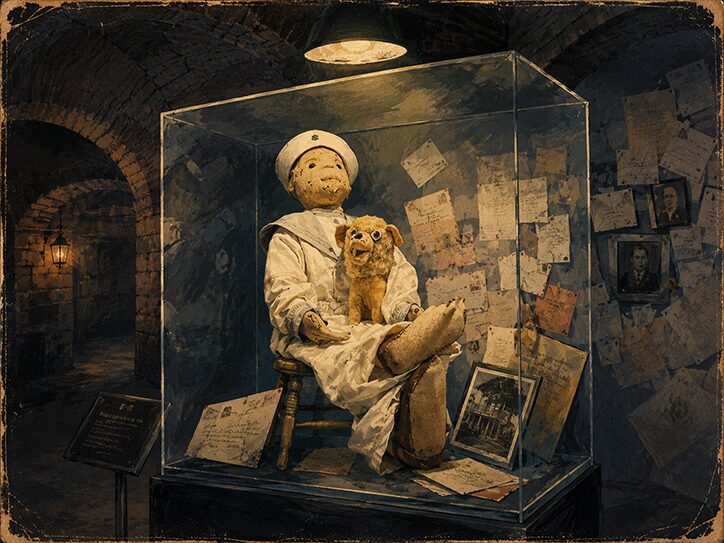
We’re going to dig into the real story, the documented facts, the disputed claims, and what’s actually happened to the doll since the Warrens passed away. If you read our post on Robert the Doll, you’ll recognize the territory. Annabelle is Robert’s better-known, more controversial cousin.
What Is the Real Annabelle Doll?
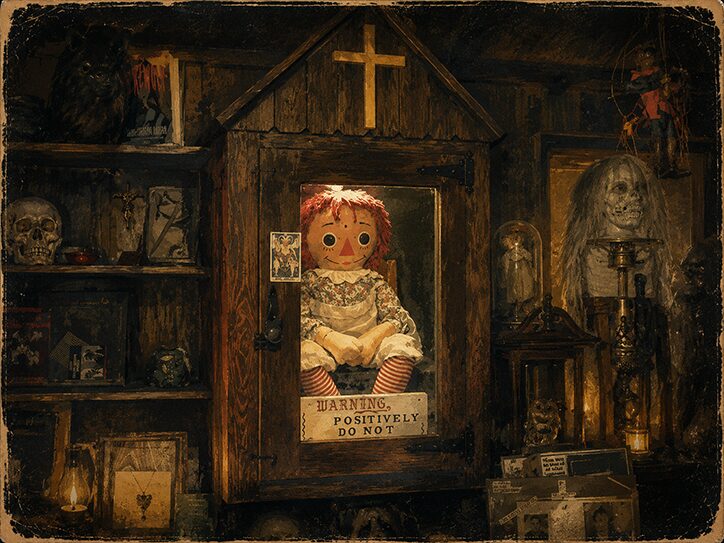
The real Annabelle is a Raggedy Ann doll, manufactured commercially in the 1960s. She’s a soft cloth doll with yarn hair, button eyes, a triangular nose, and an embroidered smile. She wears the classic Raggedy Ann outfit. A blue and white striped dress with a white apron, red and white striped stockings, and black shoes.
She’s not a one-of-a-kind antique. She’s not handmade. She’s a mass-produced toy that was probably one of thousands of identical dolls sold at department stores in the late 1960s.
Which is exactly why the story is so unsettling. There’s nothing inherently sinister about her appearance. Whatever Annabelle is supposed to be, it isn’t communicated by what she looks like.
For most of her famous life, she’s been kept in a custom glass case with a sign reading: “WARNING: POSITIVELY DO NOT OPEN.”
That sign is from Ed Warren. He believed touching her, or even removing her from the case, would have consequences.
The Origin Story: Donna and Angie
The story starts in 1970.
A nursing student named Donna received a Raggedy Ann doll as a birthday gift from her mother, who had purchased it at a hobby store. Donna was 28. She lived in a small apartment with her roommate Angie, who was also a nurse. Donna placed the doll on her bed as a decoration.
Within a few days, the women started noticing strange things.
The doll seemed to move. Not dramatically, but they’d come home and find her in a different position than they’d left her. Sitting up instead of lying down. In a different room. Once, they reportedly found her with her legs crossed in a way that would have been physically impossible for a soft-bodied cloth doll to do on its own.
Then the notes started appearing.
Small pieces of parchment paper, written in pencil in a childish scrawl, would appear around the apartment. They contained simple messages: “Help Us” or “Help Lou.” The women didn’t have any parchment paper in the apartment. Neither did anyone they knew. The handwriting didn’t match either of theirs.
According to the case as told by the Warrens, Donna and Angie eventually called in a medium, a common response in the early 1970s for unexplained phenomena. The medium told them the doll was being inhabited by the spirit of a young girl named Annabelle Higgins, who had reportedly died on the property where the apartment building now stood. She had died at age seven, the medium said, and had become attached to Donna.
Donna, sympathetic, agreed to let “Annabelle” stay in the doll.
According to the Warrens, this was the critical mistake.
The Lou Incident
The friend the doll was reportedly trying to warn them about was named Lou. He was Donna and Angie’s frequent houseguest and reportedly didn’t trust the doll from the moment he met her.
The most famous incident in the Annabelle case allegedly happened to Lou.
One night, while sleeping over at the apartment, Lou claimed he woke up unable to move. He felt something on top of him, pressing down on his chest, choking him. When he could finally move, he saw the doll at the foot of the bed.
That, in itself, would qualify as a serious paranormal experience. But what allegedly happened next is what made the case famous.
A few days later, Lou and Angie were planning a road trip. Before they left, Lou heard rustling in Donna’s bedroom. He went to investigate. When he opened the door, the doll was on the floor. When he picked her up, he reportedly felt someone watching him from behind. He turned around. No one was there.
Then he felt a sudden, sharp pain across his chest. When he pulled his shirt up, he had what looked like seven clean claw marks running down his torso. Three down, four across. They reportedly healed within two days, which is unusual for any normal wound.
This was the incident, according to the Warrens, that prompted Donna to call in religious help.
The Warrens Take Possession
Donna and Angie contacted an Episcopal priest, who referred them to a higher-ranking priest, who eventually referred the case to Ed and Lorraine Warren, at that time, the most famous paranormal investigators in the United States.
The Warrens were a husband-and-wife team based in Monroe, Connecticut. Ed was a self-taught demonologist; Lorraine claimed to be a clairvoyant. They’d already worked dozens of high-profile cases by the early 1970s, and they would later be associated with the Amityville Horror, the Enfield Poltergeist, and the Snedeker family case, all of which were turned into major Hollywood films.
When the Warrens investigated Annabelle, their conclusion was reportedly very different from what the medium had told Donna.
According to Ed Warren, there was no spirit of a young girl named Annabelle Higgins. There were no death records for any such person on the property. What Donna had actually invited in, the Warrens claimed, wasn’t a child’s spirit at all. It was an inhuman entity, a demon, that had manipulated the women through a sympathetic story to gain permission to attach itself to the doll.
The Warrens took the doll back to Connecticut with them. According to Ed, the drive home was eventful. The car reportedly stalled multiple times despite being in perfect mechanical condition. He claimed he had to repeatedly bless the doll and sprinkle holy water to get the engine to restart.
Once home, the doll was placed in a glass case in the Warrens’ Occult Museum, which was attached to their house.
Life at the Occult Museum
For nearly fifty years, Annabelle lived in that case.
The Occult Museum was, by all accounts, a remarkable place. It contained hundreds of objects the Warrens had collected from their investigations. Possessed dolls, cursed mirrors, ritual objects, items connected to murders and suicides. Each item had a story. Many had warning signs.
Annabelle’s case was always one of the main attractions. Visitors who took the museum tour, which was offered for decades, would stand in front of her glass case while Ed or Lorraine, and later their son-in-law Tony Spera, would tell her story. Visitors were repeatedly warned not to mock her, not to challenge her, and not to touch the case.
Ed Warren, until his death in 2006, would tell the story of one young man who came on a tour, mocked the doll, and dared “Annabelle” to do something to him. He left the museum, got on his motorcycle, and reportedly died in an accident before he made it home.
Stories like that became the museum’s reputation. Many of them are unverifiable. Some are clearly embellished. But the cumulative effect, over fifty years, was that Annabelle became known as the most dangerous object the Warrens had ever encountered.
Ed Warren’s Rules
Ed Warren had specific rules about Annabelle that were observed at the museum:
- Never open the case. Touching the doll directly was considered the most dangerous act possible.
- Never mock her or challenge her aloud. Visitors who taunted the doll were said to suffer consequences.
- Always treat her presence with seriousness. Joking about her in her vicinity was discouraged.
- The case was blessed. A priest had blessed the case to contain whatever the Warrens believed was attached to the doll.
When Tony Spera took over operating the Warrens’ organization after Ed’s death (and later Lorraine’s, in 2019), these rules continued to be enforced.
The “Annabelle Escaped” Panic
In August 2020, in the middle of an already chaotic year, a rumor went viral on social media: Annabelle had escaped from her case.
The story spread across Twitter, TikTok, and Facebook within hours. People claimed the doll had been moved, that she was missing, that the world was ending. Memes were made. News outlets picked it up.
Tony Spera was forced to make a video statement that same week, filmed in front of the case, showing the doll still inside and explaining that no, she had not escaped. The rumor, he said, was simply an internet hoax that had spread because 2020 was the kind of year where people would believe anything.
It’s worth noting: the rumor went viral because, for a brief moment, the entire internet collectively decided that “Annabelle escaping” was a plausible explanation for how badly everything was going that year. That’s the cultural footprint of this case. People genuinely worry about Annabelle.
The Museum’s Current Status
Here’s where the practical story gets complicated.
The Warrens’ Occult Museum, which had operated for decades from the Warrens’ property in Monroe, Connecticut, was effectively closed by local zoning officials around 2019. The museum had been operating in a residential zone for decades without the proper commercial permits, and the town finally enforced the rules. Public tours stopped.
This means that for the past several years, there has not been a way for members of the public to visit Annabelle in person. She’s still in her case. She’s still being kept by the Warrens’ family. But she isn’t on public display.
There have been occasional traveling exhibits. Tony Spera has taken some Warren artifacts on tour, including, reportedly, Annabelle herself for select events. These are typically tied to paranormal conventions, special museum partnerships, or private events. They’re not regular, predictable, or guaranteed.
If you’ve ever wondered why Annabelle, despite being arguably the most famous haunted object in the world, is so much harder to visit than Robert the Doll, that’s why. Robert is in a permanent public museum. Annabelle is in private storage.
Is the Annabelle Story Real? A Skeptic’s Take
The Annabelle case is more disputed than Robert’s, and we’d be dishonest not to acknowledge it.
What’s documented:
- A doll exists, owned by the Warren family
- The Warrens did receive the doll from a woman named Donna in the early 1970s
- The doll has been displayed in a glass case for over five decades
- The cultural and pop culture impact of the case is massive
What’s harder to verify:
- Most of the original incidents (the moving doll, the notes, the Lou attack) were reported only by Donna, Angie, and Lou, and were filtered through the Warrens’ retelling
- The Warrens have been widely accused, by skeptics and former associates, of fabricating or embellishing cases for publicity and profit
- Several other Warren cases (including the Amityville Horror) have been publicly disputed by participants and later acknowledged to have been partially or wholly fabricated
- There is no death record for an “Annabelle Higgins” matching the medium’s description
- The Lou attack has no medical documentation
- No controlled investigation of the doll has ever been conducted
Here’s our honest read: the Warrens were complicated figures. They genuinely believed in the supernatural, and they helped real people who were experiencing real distress. They also had a strong financial incentive to dramatize their cases, and they almost certainly embellished. Some of their cases have held up to scrutiny better than others. Annabelle’s specific incidents (the notes, the wounds, the moving) sit in an uncomfortable middle ground. The witnesses are sincere. The evidence is thin. The story is compelling regardless.
Whatever you believe about the original incidents, the doll has now had over fifty years of accumulated reputation. Even people who don’t believe in any of the original claims tend to feel uneasy about her. That’s worth taking seriously on its own terms.
Pop Culture Legacy: The Conjuring Universe
The Annabelle case is the foundation of one of the most successful horror franchises in Hollywood history.
The doll first appeared on screen in The Conjuring (2013), in the opening scene. The film was a massive hit, grossing over $300 million worldwide, and launched what became known as the Conjuring Universe, a series of interconnected horror films loosely based on the Warrens’ actual cases.
Annabelle then got her own film series:
- Annabelle (2014). A prequel.
- Annabelle: Creation (2017). A prequel to the prequel.
- Annabelle Comes Home (2019). Set in the Warrens’ Occult Museum.
These films took enormous creative liberties. The most famous change was making the doll a creepy porcelain figure with a cracked porcelain face, rather than the actual cloth Raggedy Ann. The filmmakers reportedly felt that the real doll wasn’t visually frightening enough to anchor a horror franchise.
The result is that millions of people now picture “Annabelle” as a Victorian porcelain horror, when the real one is a smiling rag doll. It’s one of the most successful examples of a film franchise overwriting public memory of a real artifact.
Frequently Asked Questions
Is Annabelle a Raggedy Ann doll?
Yes. The real Annabelle is a mass-produced cloth Raggedy Ann doll from the 1960s. The porcelain doll seen in the Annabelle films and The Conjuring is a fictional design created specifically for the movies.
Where is the real Annabelle Doll now?
She’s in the possession of the Warren family, in storage at their property in Monroe, Connecticut. Since the Warrens’ Occult Museum was closed by local zoning officials around 2019, she has not been on regular public display.
Can you visit Annabelle?
Not easily. The public museum is closed. Tony Spera, who runs the Warrens’ organization, occasionally brings Warren artifacts (including, reportedly, Annabelle) to paranormal conventions and special events. If you want to see her in person, you’d need to watch for those rare public appearances.
Who owns the Annabelle Doll?
She’s owned by the Warren family. After Ed Warren’s death in 2006 and Lorraine Warren’s death in 2019, their daughter Judy and son-in-law Tony Spera have continued to manage the Warrens’ collection.
Did Annabelle really escape in 2020?
No. A rumor spread on social media in August 2020 claiming Annabelle had escaped from her case. Tony Spera filmed a video showing the doll still in her case to debunk the rumor. She has never escaped.
Did Annabelle really kill someone?
The Warrens told a story about a young man who mocked the doll and died in a motorcycle accident shortly after leaving the museum. The story has been repeated for decades, but there is no public documentation, name, or verifiable record of this incident.
Who was the real Annabelle Higgins?
According to the Warrens, no one. They claimed the spirit of “Annabelle Higgins” was an invention by a demonic entity to manipulate the original owner into granting permission for it to attach to the doll. No death records support the existence of a young girl by that name in the relevant area.
Is the Conjuring Universe based on real events?
It’s based on real Warren cases, but the films take significant creative liberties. The cases themselves are real (in the sense that the Warrens investigated them); the supernatural elements depicted in the films are dramatized far beyond what was documented.
The Bottom Line
Annabelle’s case sits in an interesting place. The doll is real. The Warrens were real. The story they told about her shaped paranormal culture in America for fifty years and gave Hollywood one of its most successful horror franchises. But the original incidents are thinly documented, the chief witnesses are connected to people with strong financial reasons to dramatize the case, and the doll herself has been largely inaccessible to the public for years.
That doesn’t mean nothing happened. It means the case sits closer to “legend” than to “documented haunting,” and anyone telling you with absolute certainty what Annabelle is (demonically possessed, completely fake, somewhere in between) is overstating their evidence.
What’s not in doubt is the cultural footprint. A regular cloth Raggedy Ann doll became, through five decades of storytelling, one of the most feared objects in the world. People genuinely panicked at the rumor of her “escape.” Millions of people who’ve never seen a real photograph of her can describe her in detail, even though what they’re describing is a movie prop, not the actual artifact.
That’s a powerful kind of haunting all on its own.
If you’ve followed the Annabelle case for years, attended one of the Warren museum tours back when they were operating, or seen her at a paranormal convention, we’d love to hear about it. Send us your story through our contact page. Firsthand accounts go into our paranormal experiences archive.
For more research into haunted objects, famous cases, and the locations behind paranormal history’s most enduring legends, subscribe to the newsletter. We don’t fluff. We don’t dramatize. We just dig in.
And if you ever do get the chance to stand in front of Annabelle’s case, follow Ed Warren’s rules. Don’t mock her. Don’t challenge her. Don’t touch the case.
You can decide for yourself what you believe after.