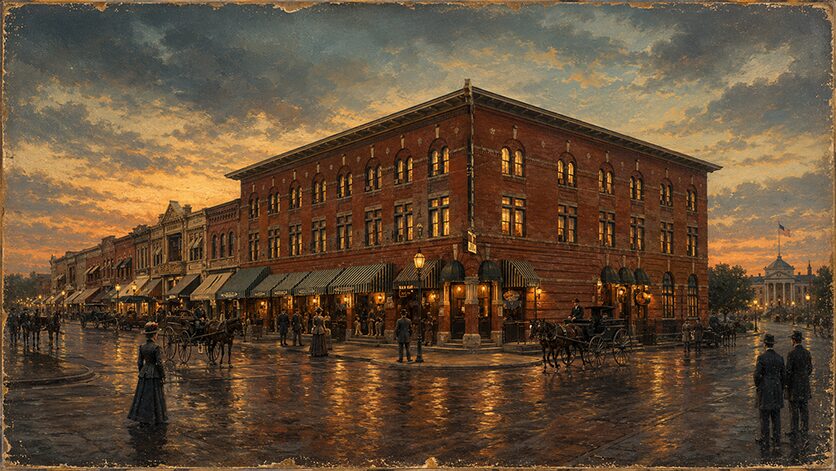
The first thing you notice about the Hotel St. Michael isn’t inside the building. It’s on the outside, near the top, just below the roof line. A row of stone faces stares down at you from the brick. Some of them are grimacing. Some look angry. A few are clearly meant to be unflattering. There’s also a wolf head, and a ram’s head, mixed in.
They’ve been there since 1901. Nobody officially knows who they’re supposed to be.
That’s the part of this hotel that finally got us to book a room. We’ve driven past it on Whiskey Row in Prescott more times than we can count, always staring up at those faces, always saying “we should stay there sometime.” When we finally booked a night, we asked for a top-floor room with a view of the Courthouse plaza. Partly because the third floor is reportedly the most paranormally active part of the building. Mostly because we wanted to be as close to those faces as we could get.
This is the research we did before walking in. Our field report from Room 326 covers what actually happened.
What Is the Hotel St. Michael?
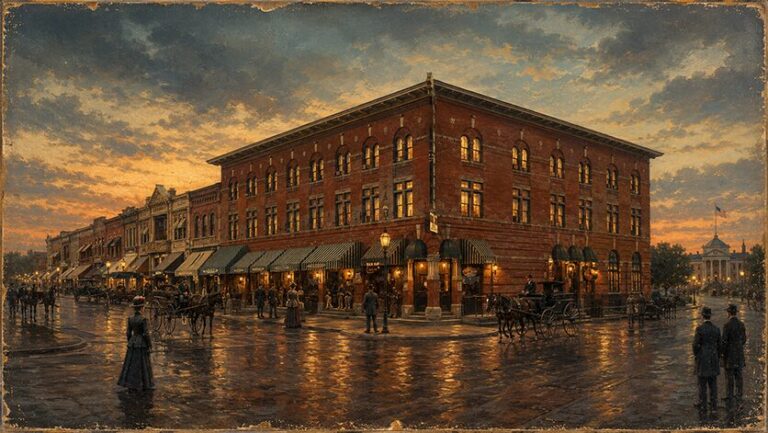
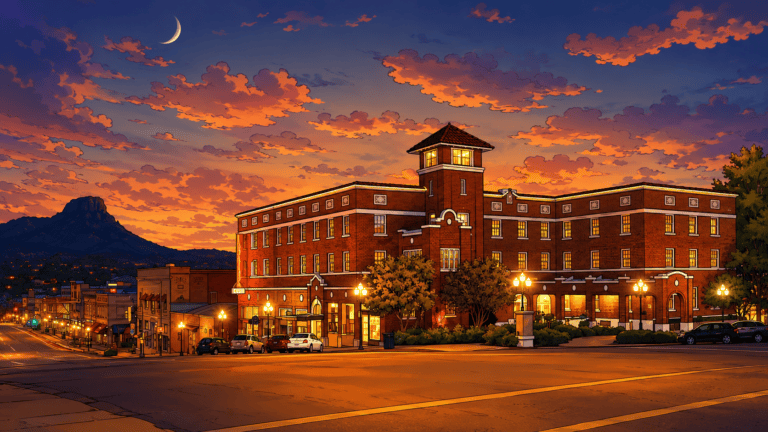
The Hotel St. Michael is a three-story brick hotel at 205 W. Gurley Street in Prescott, Arizona, sitting on the southwest corner of the Courthouse Plaza at the head of Whiskey Row. It’s been continuously operating since 1901, which makes it one of the oldest hotels still doing business in Arizona.
It was designed by architect D.W. Millard in the Second Renaissance Revival style, built of brick and stone, and opened on June 1, 1901. Originally it had 110 rooms and a stone basement, and was advertised as the most modern, most fireproof, most up-to-date hotel in the Arizona Territory. After more than 120 years and several renovations, it now operates as part of the Best Western Premier Collection with 73 guest rooms.
The building has hosted U.S. presidents, frontier outlaws, boxing champions, Western film stars, novelists, and senators. Doc Holliday lived a couple of blocks away. The Earp brothers spent time in Prescott. The Palace Saloon next door, where Doc Holliday drank Old Overholt whiskey, is still operating as Arizona’s oldest saloon. The Hotel St. Michael is the cornerstone of all of it.
It’s also said to be haunted.
The Faces on the Wall
We’re going to spend a section on this because it’s been bothering us for years, and because we know we’re not the only ones.
Look up at the front and side roof lines of the Hotel St. Michael, and just below the cornice, set into ornamental circles between the top-floor windows, there are roughly a dozen carved stone faces. Most of them are clearly meant to be human, but they don’t look like classical architectural decorations. The features are exaggerated. The expressions are pinched, sour, occasionally outright ugly. Mixed in with the human faces are a wolf and a ram.
According to the official Arizona historical marker on the building, these stone faces are “gargoyles” which allegedly represent crude images of local politicians. The story passed down through Prescott historians is that the sculptor, whose identity has never been definitively established, was settling a score with the prominent men of the day. The hotel’s owner, John Duke, supposedly didn’t object. Some accounts go further and say the faces are deliberate caricatures of specific real people. Bankers. Saloon owners. Members of the territorial government.
Other Prescott historians have offered a softer interpretation. In medieval European tradition, gargoyles were placed on buildings to ward off evil spirits and protect the people inside. By this theory, the faces on the Hotel St. Michael were placed there to guard the guests, and any resemblance to specific people is incidental.
Here’s the honest truth: nobody can prove which interpretation is correct. The original architectural records don’t identify the sculptor by name. None of the faces are labeled. Whatever story the sculptor was telling, he or she took it to the grave.
What’s not disputed is that for over a century, those faces have been staring down at the people of Prescott. If you’ve ever stood on the Courthouse Plaza and looked across Gurley Street, you’ve felt them. That’s the part that brought us in.
The History: From the Burke to the St. Michael
The site where the Hotel St. Michael now stands wasn’t always occupied by this building. From 1891 to 1900, the same corner held a different hotel, called the Hotel Burke, a wooden structure that served the rowdy mining town that Prescott was at the time.
The Burke was advertised as fireproof. It wasn’t.
On the evening of July 14, 1900, a fire broke out in a room on the second floor of a building on Goodwin Street, two blocks from the courthouse. Whiskey Row at the time was almost entirely wooden construction, and the fire spread fast. By the time it was extinguished the next morning, the entire commercial heart of downtown Prescott had burned. Saloons. Hotels. The Hotel Burke. Almost everything on Whiskey Row was reduced to ashes.
This is one of the most important moments in Prescott’s history, and it shaped what came after. When the rebuild started, the city changed its construction code. Brick and stone, not wood. Real fireproofing. Modern utilities. The buildings that line Whiskey Row today, including the Hotel St. Michael, are the post-1900 rebuild.
The Hotel Burke property was purchased by a developer named John Duke, who commissioned the new building. D.W. Millard designed it. Construction was complete in less than a year. The Hotel St. Michael opened June 1, 1901, with 110 rooms, the most modern amenities of its era, and a building proudly described in newspaper ads as truly fireproof.
One small irony of the paranormal angle: any spirits who might be tied to the property could, in theory, be carrying memory of both buildings. The Hotel Burke is gone. But it’s gone under the Hotel St. Michael, not next to it.
Whiskey Row and Prescott’s Frontier Era
To understand why the Hotel St. Michael has the reputation it does, you need to understand what Prescott was when the hotel was built.
Prescott was founded in 1864 by an act of Congress signed by Abraham Lincoln, who wanted to secure the area’s gold and silver mines for the Union side during the Civil War. It was also designated the first capital of the Arizona Territory. By the 1880s and 1890s, the town was a hub for miners, ranchers, prospectors, and everyone who made a living off them. Gamblers. Saloon keepers. Sex workers.
The stretch of Montezuma Street facing the courthouse became known as Whiskey Row, named for the row of saloons that operated along it. At one point there were more than 20 saloons within a few blocks. The most famous, the Palace Saloon, still stands today, and is recognized as the oldest continuously operated saloon in Arizona.
Doc Holliday lived in a house on Montezuma Street, just steps from where the Hotel St. Michael now stands. He drank at the Palace. He gambled in the back rooms. The Earp brothers, including Wyatt, also spent time in Prescott during this era, and the Earps and Doc Holliday were friends.
If you’ve ever wondered what an actual American frontier town looked and felt like, Prescott during this period is one of the closest historical examples available. And the Hotel St. Michael, built right at the tail end of the frontier era, is one of the few buildings that survived to tell about it.
Notable Guests Over the Years
The Hotel St. Michael claims a long list of historic guests. Some are well documented. Some are likely embellished. We’ve separated them as honestly as we can:
Documented:
- John L. Sullivan, the bare-knuckle boxing champion
- Jake Kilrain, another bare-knuckle boxing legend
- Tom Mix, the silent-era cowboy film star
- Zane Grey, the Western novelist
- Senator Barry Goldwater, who gave political speeches in the hotel’s ballroom and used Prescott as a regular base of operations during his campaigns
A personal note: I had the chance to meet Goldwater in high school. He was a lifelong amateur radio operator with the call sign K7UGA, and as well known in the ham radio community as he was in politics. Of all the public figures I’ve crossed paths with over the years, he stands out. He was, as anyone who ever shook his hand will tell you, an amazing and kind man.
Disputed or unclear:
- Theodore Roosevelt. The hotel and many tour operators claim he stayed there. The historical record actually shows the opposite. In 1911 he was invited to visit Prescott and declined, and the contemporary newspaper account confirms he passed through on a train without stopping. He may have visited earlier, but no clear record places him as an overnight guest.
- Billy the Kid. Sometimes claimed. There’s no documented record we could verify of him staying here.
- Wyatt Earp and the Earps. Spent time in Prescott. Whether they specifically stayed at the Hotel St. Michael is less clear, since the building wasn’t constructed until 1901 and Wyatt Earp’s most famous Prescott connections predate that.
We mention this not to undercut the hotel’s history, which is genuinely rich, but because honest history is more interesting than embellished history. The documented guest list alone is impressive without needing Roosevelt or Billy the Kid added on.
The Otis Elevator
One detail of the Hotel St. Michael that always comes up in reviews and paranormal investigations: the original Otis Traction Elevator, installed in 1925. It was the first elevator installed in the city of Prescott, and it still works.
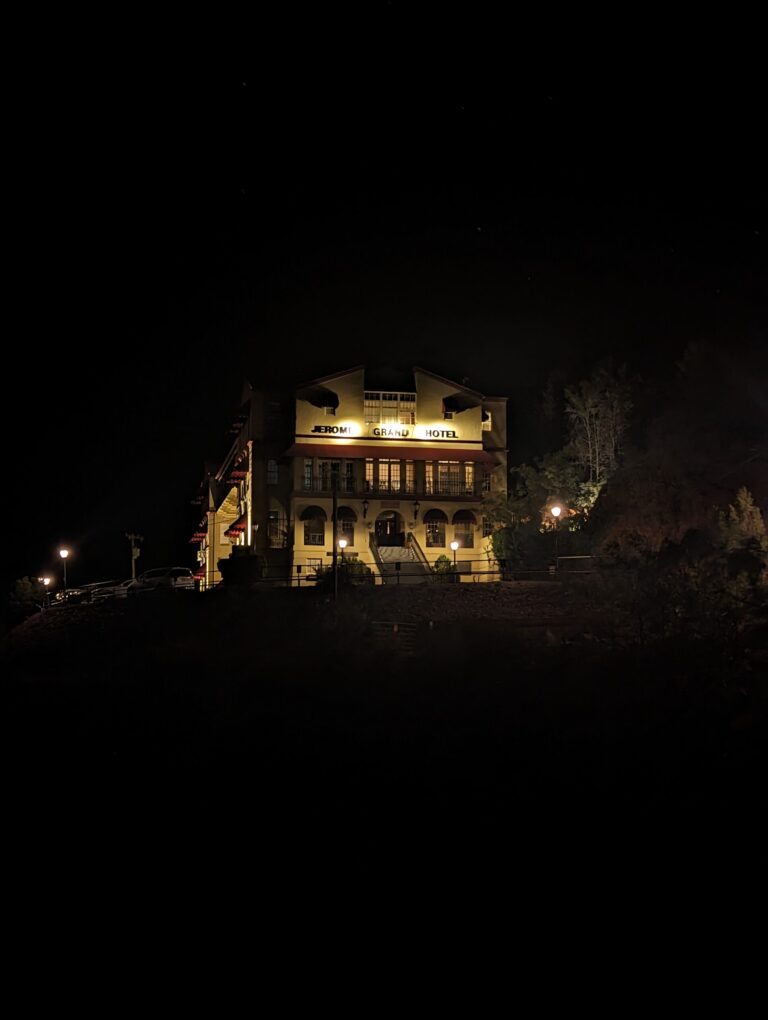
If you’ve read our Jerome Grand Hotel field report, you’ll recognize the type. The Jerome Grand has an even older Otis from 1926. Riding one of these is one of those experiences that makes a building feel like its actual age. Manual cage door, creaking cables, slow ascent, every floor visible through the gap as you pass.
Guests have reported strange experiences in and around the elevator at the Hotel St. Michael. Doors that open without being called. Cold spots when entering. The car arriving on a floor with no one inside.
For us, that’s high on the list of things to pay attention to.
The Paranormal Reputation
This is where it gets interesting.
The Hotel St. Michael has been included on essentially every Prescott ghost tour for decades, including the one operated by Phoenix Ghosts and the Freaky Foot Tours “Ghosts of Downtown Prescott” tour. Local Arizona paranormal investigation groups, including Entity Voices, have investigated it. It comes up frequently in conversations about the most haunted hotels in Arizona, often in the same breath as the Hotel Vendome, the Hassayampa Inn, and the Jerome Grand.
The specific claims center on three areas: the third floor, the elevator, and the main staircase.
The Third Floor and the Lady
The third floor of the Hotel St. Michael is where the most-reported paranormal activity takes place. Front desk staff have reportedly confirmed to guests on multiple occasions that the third floor, and specifically a handful of rooms on it, are the most active.
The rooms that come up most often in reports:
- Room 315: Multiple accounts of a “ghostly lady” who makes her presence known through cold spots, lights cycling on and off, and a strong floral or perfume smell
- Room 312: Featured in social media accounts of paranormal experiences
- Room 325: Specifically cited by hotel staff as one of the three most haunted rooms on the floor
The figure most often described is a woman in late-1800s dress, sometimes interpreted as a “lady of the night” or sex worker from Prescott’s frontier era. She’s been reported on the third floor, in the third-floor hallway, on the main staircase, and occasionally on the second floor as well. She doesn’t appear to be aggressive. Most accounts describe her as curious, sometimes playful, occasionally just standing in a doorway watching.
The single most consistent manifestation associated with her is the perfume. Multiple guests, across multiple decades, have reported a strong floral scent appearing suddenly in a hallway or room, often described as old-fashioned, powdery, and reminiscent of the kind of perfume worn around 1900. One particularly notable account, posted on All Stays in 2003, described the scent appearing in a stairwell, lingering, and then a husband waking up later that night to hear a woman’s voice at the foot of the bed say clearly: “Show your face.”
The Elevator and Staircase
The Otis elevator gets mentioned in roughly half the paranormal accounts we read. The most common reports are of the elevator arriving on a floor when no one called it, doors opening on their own, and unexplained cold spots inside the car.
The main staircase has its own reputation. Guests have reported the smell of perfume drifting up or down the stairs, footsteps on the steps when no one is visible, and the sense of being watched while ascending alone late at night.
Other Reported Phenomena
Across the various accounts we reviewed, the following also come up:
- Knocks on doors with no one on the other side
- Whispers in rooms when guests are alone
- Sudden, unexplained nausea or dizziness in specific spots
- Lights turning on and off independently
- EMF spikes during investigations, particularly on the third floor
- Voice phenomena captured on audio recordings
That’s a relatively standard list of phenomena for a hotel of this age, and we’d be skeptical of any building that didn’t have at least some of these reports after 124 years. What stands out at the Hotel St. Michael is the specificity of the lady and the perfume, which keeps showing up across decades of independent accounts.
A Skeptic’s Take
We try to be honest about what we can and can’t verify, and the Hotel St. Michael is a good case for it.
What’s documented:
- The hotel’s history is well established, from the Burke through the 1900 fire through the current building
- The architecture and the carved faces are real and verifiable
- The third-floor reputation is consistent across many independent guests over decades
- Multiple paranormal tour operators and investigation groups have included it in their work
What’s harder to verify:
- The identity of the “lady” as a specific historical person. The frontier-era sex worker framing is plausible given Prescott’s history, but we couldn’t find a death record, name, or specific historical incident tied to her
- The connection between the Hotel Burke and current paranormal claims. People sometimes mix these up
- Smell-based phenomena are particularly susceptible to suggestion and to mundane explanations. Hotel hallways have lingering scents from cleaning products, guests, food, all of which can be interpreted as paranormal if you’re already primed for it
- The hotel sits in the middle of Whiskey Row, which is loud, social, and full of distractions, all of which can lead to misinterpretation of normal sounds
Our read going in: the third-floor reports are remarkably consistent across decades, which is unusual and worth taking seriously. The perfume claim specifically is harder to fake or imagine collectively. Whether that translates to a genuine paranormal presence or just an unusually “sticky” cultural memory of one, we don’t know yet. That’s part of what we’re going to try to figure out.
Why We Picked It
We’ve stayed at the Hotel Vendome, two blocks away. We’ve spent days walking through Prescott. We’ve sat in the Palace Saloon and looked at the photos on the walls. But we’d never spent a night inside the Hotel St. Michael, and the faces above the third floor have been on our list for a long time.
The booking was simple. One night. A standard room with a Courthouse Plaza view. Top floor requested.
We wanted the top floor partly because the third floor’s paranormal reputation is what it is, and we’d rather be in the building’s most active area than its quietest. We also wanted the plaza-facing view because that’s the side of the building with the faces, and we wanted to be able to look out over them.
It turned into a Prescott haunted hotels project. We’ve since stayed at all three, the Vendome, the St. Michael, and the Hassayampa Inn, and ranked them head to head in our Prescott haunted hotels comparison.
What We’re Bringing
The usual kit. EVP recorder running through the night, EMF meter for baseline and spot checks, spirit box for short sessions in the room and hallway. Our gear setup is documented in detail on the Our Gear page if you want to know what we actually carry.
We’re also testing a new piece of gear on this trip: the Ray-Ban Meta Wayfarer Gen 2 smart glasses, for hands-free POV capture. We’ve been considering them for a while, and the Hotel St. Michael trip felt like the right place to put them through their first real investigation. We’ll have honest notes on how they actually performed in the field report.
How to Visit the Hotel St. Michael
If you want to stay there yourself, here’s the relevant information:
Location: 205 W. Gurley Street, Prescott, AZ 86301, on the corner of Gurley Street and Montezuma Street, directly across from the Yavapai County Courthouse.
Booking: The hotel operates as part of the Best Western Premier Collection. You can book directly through their website at stmichaelhotel.com, through Best Western, or through any of the major booking platforms.
Pricing: Generally in the $110 to $175 per night range depending on season and room type. Weekends are more expensive than weekdays, and the summer Prescott Frontier Days rodeo period drives rates significantly higher.
Rooms to request if you want active areas:
- Third floor, any room
- Specifically Room 315, 312, or 325 if available
- Plaza-facing for the view of the carved faces
On-site dining: Bistro St. Michael (lobby-level restaurant) and Fire & Sword (the hotel’s restored speakeasy). The bistro is reportedly very good. The speakeasy is one of the more atmospheric craft cocktail bars in northern Arizona.
Realistic expectations: This is a 1901 historic hotel, not a modern boutique. Rooms are smaller than what you’d get at a Hilton. Some have limited electrical outlets. The walls aren’t soundproof, and Whiskey Row is loud on weekends. Earplugs are provided, but you may want to bring better ones. The Otis elevator is slow and authentic, which is part of the experience.
What to pair it with in Prescott: The Palace Saloon next door, the Courthouse Plaza across the street, the Sharlot Hall Museum two blocks behind the hotel, and the rest of Whiskey Row. If you have time, a ghost tour through Freaky Foot Tours or Phoenix Ghosts will give you context for the whole downtown that you can’t get otherwise. The Hotel Vendome is a fifteen-minute walk and worth a visit even if you’re not staying there.
Frequently Asked Questions
Is the Hotel St. Michael in Prescott really haunted?
It’s one of the most consistently reported haunted hotels in Arizona. The third floor in particular has decades of independent guest reports of paranormal activity, including a recurring “lady” figure and strong perfume scents. Whether you accept those reports as evidence of genuine paranormal activity depends on your own beliefs.
What are the carved faces on the Hotel St. Michael?
They’re stone faces set into ornamental circles below the roof line. The Arizona historical marker calls them “gargoyles,” and Prescott tradition holds that they’re crude caricatures of local politicians and businessmen from the era, possibly sculpted as revenge by an unknown artist. The hotel also includes a wolf head and a ram’s head among the human faces.
When was the Hotel St. Michael built?
The Hotel St. Michael opened on June 1, 1901, on the site of the earlier Hotel Burke, which had burned in the Great Whiskey Row Fire of July 1900. It was designed by D.W. Millard in the Second Renaissance Revival style.
Which floor is the most haunted at the Hotel St. Michael?
The third floor, by a significant margin. Rooms 315, 312, and 325 in particular come up repeatedly in paranormal accounts.
Who is the ghost at the Hotel St. Michael?
The most-reported figure is a woman in late-1800s dress, often interpreted by tour guides and paranormal investigators as a sex worker from Prescott’s frontier era. Her specific identity has never been documented. She’s most often experienced through cold spots, a strong floral or powdery perfume smell, and occasional voice phenomena.
Did Theodore Roosevelt stay at the Hotel St. Michael?
Probably not, despite the hotel’s frequent claim. Historical records show that in 1911 Roosevelt was invited to visit Prescott and declined, and contemporary newspaper accounts note that he passed through town on a train without stopping. The claim has been repeated for decades but isn’t well supported by the documentary record.
How old is the elevator at the Hotel St. Michael?
The Otis Traction elevator was installed in 1925, making it the first elevator installed in the city of Prescott. It still operates today.
Can you visit the Hotel St. Michael without staying overnight?
Yes. The lobby is open to the public, and you can eat at Bistro St. Michael or drink at the Fire & Sword speakeasy without being a registered guest. Several Prescott ghost tours include the exterior of the hotel as a stop and discuss its history and reputation.
The Bottom Line
The Hotel St. Michael is the kind of building that earns its reputation through a combination of real history, distinctive architecture, and the simple fact that it’s been standing in the same spot through every era of Arizona’s modern history. It’s survived a fire that destroyed almost everything around it. It’s hosted real frontier figures, real boxers, real Western film stars, and real politicians. It still has the same Otis elevator that’s been climbing through its floors since 1925. And it still has those carved faces on the outside, staring down at every person who walks across the Courthouse plaza.
Whether the third-floor lady is real or not, that’s what we’re going there to try to find out. We can’t promise our stay will turn up anything definitive. Plenty of guests stay there and report nothing. We could be one of them. But we’ve done the research, we know what to pay attention to, and we have the gear to document whatever happens.
Our field report from Room 326 is up now.
If you’ve stayed at the Hotel St. Michael yourself, especially on the third floor, we’d love to hear about your experience. Send us your story through our contact page. Firsthand accounts go into our paranormal experiences archive.
For more research into Arizona’s most haunted hotels and the history behind them, explore our Haunted Hotels archive or subscribe to the newsletter. No fluff. No dramatization. Just the stories, and what actually happened.