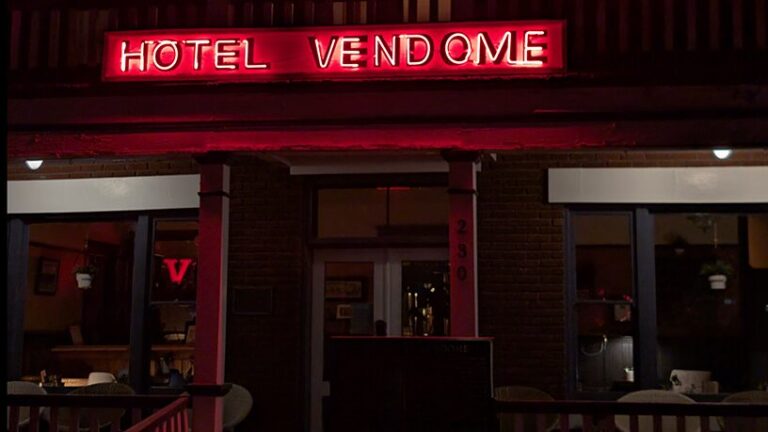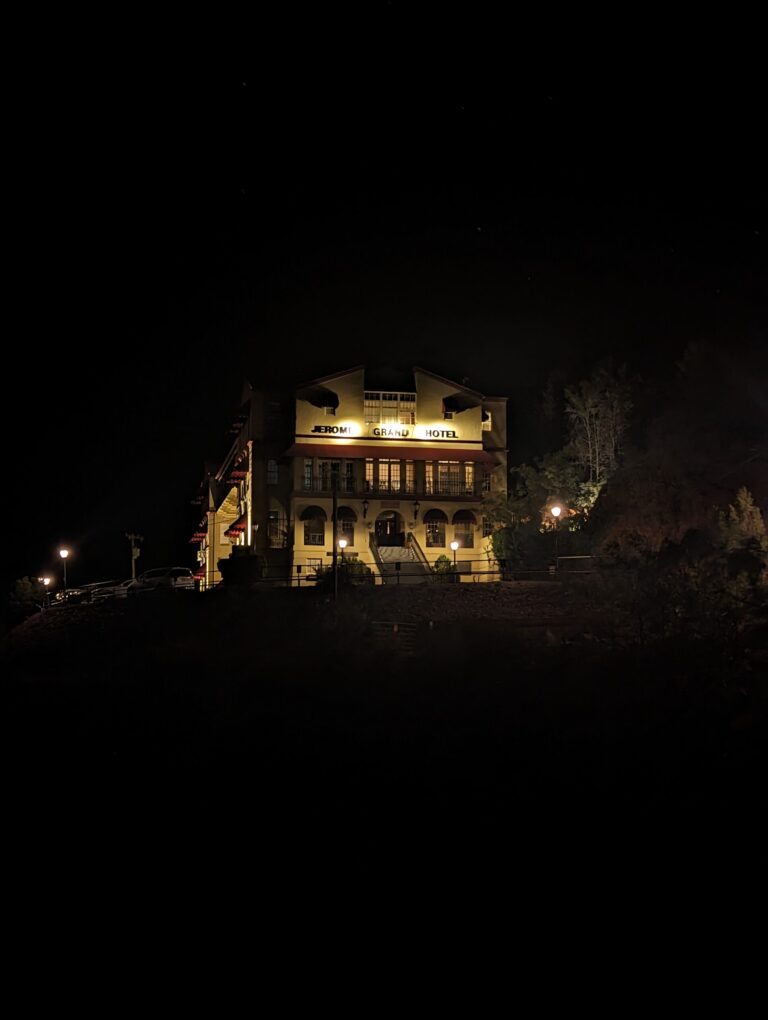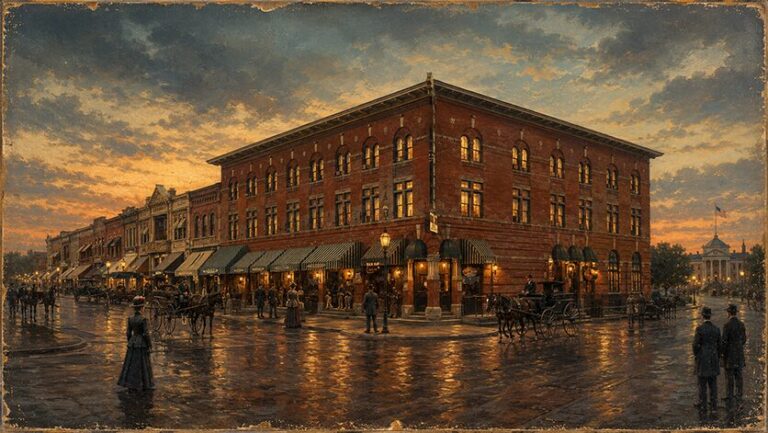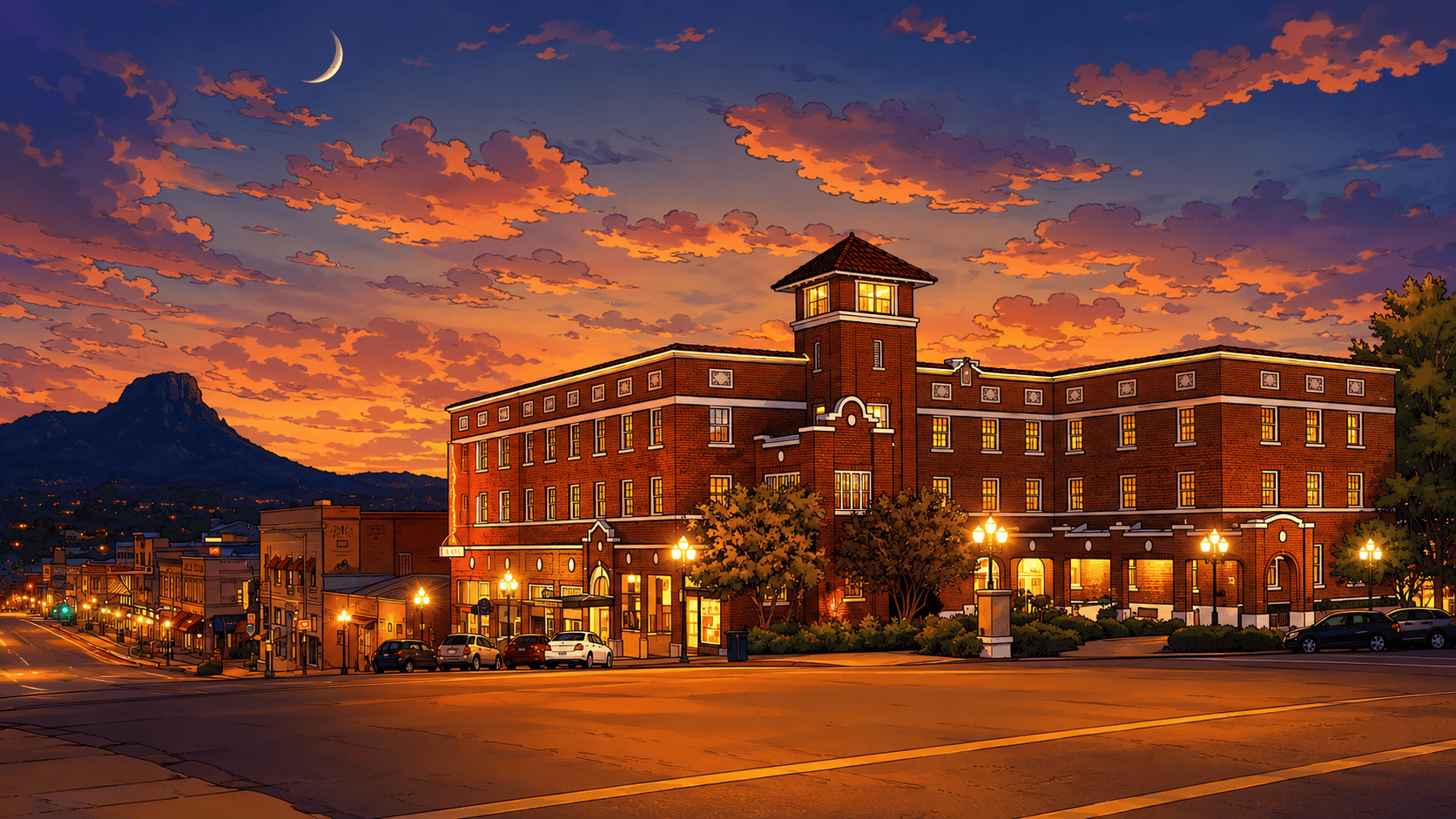
The Hassayampa Inn sits a block off the Courthouse Plaza in downtown Prescott, a four-story red-brick landmark with a bell tower, a porte-cochère, and a name that doesn’t sound like a hotel until you’ve heard it a few times. It’s been on our Arizona list as long as the Hotel Vendome and the Hotel St. Michael, the three big haunted hotels of Prescott. We’ve already covered the other two, both their histories and our field reports from our stays. The Hassayampa was next.
This is the research post. The history, the building, the famous ghost, the lesser-known ghosts, and what we read going in. Our field report from the actual stay is a separate piece. We always do it this way because the legend and the experience are two different things, and they deserve to be treated separately.
Here’s everything we wanted to know about the Hassayampa Inn before we walked in.
About the Hassayampa Inn
The Hassayampa Inn opened on November 20, 1927. It was the first “community” hotel in Prescott, meaning it was financed not by a single owner or a large hotel chain but by hundreds of local citizens who bought shares to make it happen. Over 450 local investors subscribed a total of about $200,000 to fund the construction, with some shares sold for as little as $1. The drive was led by Grace M. Sparkes, the Yavapai County Chamber of Commerce Secretary, who spent seven years (from 1920 to 1927) keeping the project alive and rallying the community to invest. The original entity was called the Hassayampa Hotel Company.
The hotel was Prescott’s answer to a question that the rest of Arizona was already asking in the 1920s. Phoenix, Tucson, and Flagstaff were all positioning themselves for the new “auto tourist” economy, the wave of middle-class American travelers who were starting to load up their Model T’s and drive across the country for vacation. Prescott, which had been the territorial capital twice (1864 to 1867 and again 1877 to 1889) and was now the Yavapai County seat, needed a hotel that could compete. The Hassayampa was that hotel.
It was built on the site of the former Conner Hotel, which burned to the ground in 1923. That detail matters later when we get to the ghosts. For now, just note that the land had already absorbed one major hotel fire by the time the Hassayampa rose on top of it.
The building was designed by the firm of Trost and Trost from El Paso, Texas, with Prescott architect Chris Totten serving as architect of record. Henry Trost was the lead designer. By the mid-1920s, Trost and Trost was the most established architectural firm in the American Southwest, with hotel work across Arizona, New Mexico, and West Texas. Construction was handled by the Ramey Brothers, also from El Paso. Ground was broken on February 28, 1927. The hotel opened a little over eight months later.
The architecture is a blend of Mission and Spanish Colonial Revival with Italian Renaissance Revival accents. Red brick exterior. A bell tower (a campanile) topped with an illuminated pinnacle. A porte-cochère for arriving automobiles. Hand-painted wood ceilings inside. Etched and stained glass. Embossed copper panels and Arizona copper cornices. Wrought-iron chandeliers. Tiffany lamps. A talavera tile fireplace in the lobby. An Otis elevator. The original room count was 88. After the 1985 restoration, that number was reconfigured to 67 rooms including 12 suites.
The Hassayampa was listed on the National Register of Historic Places in 1979 and has been a member of Historic Hotels of America since 1996.
The Name and the River
The hotel takes its name from the Hassayampa River, which runs through central Arizona north of Prescott. The word “Hassayampa” comes from Apache and loosely translates to “the river that loses itself.” That’s a literal description. For much of its 100-mile course, the Hassayampa River disappears beneath the surface and flows underground through the desert before reappearing.
It’s a strangely fitting name for a building that, depending on which story you believe, has held onto more than its share of people who don’t appear to have moved on either.
The Decline and the Restoration
The Hassayampa was Prescott’s premier hotel from 1927 through the 1950s. Celebrities of the era stayed there. Tom Mix, who was making black-and-white Western movies in Prescott in the late 1920s and early 1930s, used the hotel as his base. Will Rogers stayed. Greta Garbo stayed. Clark Gable. Georgia O’Keeffe. In later decades the guest book would include Tom Selleck, The Beach Boys, John McCain, and George W. Bush.
By the 1960s, the hotel was struggling. The rerouting of U.S. Highway 89 away from Gurley Street pulled travelers off the historic downtown corridor, and new motels on the outskirts of Prescott absorbed the highway business. The owners at one point proposed demolishing the hotel and rebuilding it as a midcentury modernist motel. That plan never happened, but the building sat in slow decline through the 1970s, and talk of tearing it down kept resurfacing.
The save came in the mid-1980s. New owners brought in Prescott architect Bill Otwell, working with the Phoenix architectural firm Allen and Philip, for a major restoration. The five-month project added private bathrooms (many of the original rooms had shared facilities), modernized the heating and cooling, brought the building up to current fire safety standards, and reconfigured the guest room count. It also restored a number of original features that had been lost over the decades, including the lobby fountain in the entry court and the painted decorative ceiling.
The hotel that you walk into today is the 1985 restoration. The bones are 1927. The systems are modern. The decor pulls heavily from the original 1920s palette.
The Story of Faith Summers
Every haunted hotel has a signature ghost. At the Vendome it’s Abby and her cat Noble. At the Hotel St. Michael it’s whoever still seems to be active in Room 325 and the surrounding third-floor corridor. At the Hassayampa, it’s Faith.
The story, as it’s most commonly told, goes like this. Sometime shortly after the hotel opened in 1927 (some retellings put it in early 1928), a young bride named Faith Summers checked into the Hassayampa for her honeymoon with a much older husband. They were given the Grand Balcony Suite, Room 426, the hotel’s most coveted room. On their first night, Faith’s husband told her he was going out to buy a pack of cigarettes.
He never came back.
Faith waited in Room 426 for three days. By the version of the story that most local guides tell, no one knows what was going through her head during those three days. She came down to the lobby. She wandered the hallways. She waited. On the third day, in despair, she hanged herself. Different sources describe the death scene differently. Some say she hanged herself inside Room 426. Some say she hanged herself from the balcony just outside her room. Some say she hanged herself from the flagpole or the bell tower above the hotel. The most lurid version of the story says her body was visible from Gurley Street below for some time before staff found her on the fourth day.
If you’ve already read our research on the Hotel Vendome, the structure of this story will feel familiar. Both legends involve a young woman abandoned by a husband or partner, both involve a long wait in a specific room, both end with the woman dying in that room. The “husband went out for cigarettes” detail is a frequently recurring trope in American hotel ghost stories. The Vendome’s Abby has the same beat. The honest read is that some of these stories share narrative DNA, and the specifics may have drifted or been consolidated over the decades.
That doesn’t mean the story is invented. It means the documentation is thin. A real woman may have died at the Hassayampa in the late 1920s and the legend may have grown from there, with embellishments accumulating across nearly a century of retelling. Or the entire story may be folklore. Records that would conclusively confirm Faith Summers as a documented person who died at the hotel in 1927 are not widely published, and the hotel itself treats the story as legend rather than verified history.
What’s harder to dismiss is the volume and consistency of paranormal reports from Room 426 and the surrounding hallways, regardless of whether Faith herself ever existed as the story claims.
What Guests and Staff Report
The paranormal reports at the Hassayampa cluster around a handful of recurring phenomena. Across guest accounts, employee accounts, and paranormal investigators who’ve worked the building, the same things keep coming up.
The apparition itself. Faith is most often described as appearing in a pink gown, sometimes called a wedding dress in older accounts. She is sometimes seen carrying a bouquet of flowers. She has been described floating down the fourth-floor hallway, disappearing into rooms (often Room 426 itself), or sitting at the end of a guest’s bed and crying. Some guests have reported feeling the weight of someone sitting on the mattress beside them in the night, only to find no one there.
The scent of flowers. Multiple guests, staff members, and tour guides have reported a strong floral scent in the hallway outside Room 426 and inside the suite itself. The scent is most often described as resembling 1920s-style floral toilet water, the kind of perfume Faith might plausibly have worn. Hotel management has said over the years that the scent has resisted attempts to remove it.
Cold spots. Room 426 is reported to have specific cold spots, particularly near the bed. The cold spots are sometimes accompanied by the floral scent described above.
Electrical disturbances. The television and radio in Room 426 turning themselves on, often at full volume, sometimes in the middle of the night. Lights coming on. Bathroom faucets running on their own. A wreath flying off the door of Room 426 while a housekeeper was working in the hallway.
The kitchen. Multiple kitchen staff have reported that the gas burners on the stove will go out unexpectedly, particularly when they’re aware of Faith’s presence in the room. Faith is sometimes reported in the Peacock Room, the hotel restaurant, and in the bar adjacent to it.
The “don’t talk about Faith” phenomenon. This one is specific to the Hassayampa and is worth flagging. Multiple sources, including paranormal tour guides who work the hotel, report that Faith seems to react to people discussing her story. The most-cited example is a woman whose coffee jumped out of her cup at the mention of researching Faith’s suicide, while standing directly in front of Room 426. Other guests and staff have reported similar reactions to talking about the story openly within the building.
Reports of Faith range from gentle (the crying at the bedside, the scent of flowers) to emotionally charged (the TV and radio at full volume in the middle of the night, the wreath being thrown). Some guests describe her as melancholy. Others describe her as angry, particularly male guests staying alone in Room 426, who have reported more aggressive experiences. The story version that the hotel staff sometimes shares is that Faith is kinder to female guests in her suite and harder on men, which (if you accept the premise) matches with her own story of being abandoned by her husband.
The Other Ghosts
Faith is the famous one, but she’s not the only reported presence at the Hassayampa.
The Night Watchman. An older man, described as wearing Old West attire, sometimes a brown coat. He is most often seen in the lobby, sitting in a chair near the fireplace, reading a newspaper or simply staring into the flames. He has also been reported in the Peacock Room, sitting at a round table by the pianos late at night after the dining room has closed. One Hassayampa hostess, working a late close, asked the man at the table if she could turn the lights on for him. When she flipped the switch, he vanished. Multiple staff members over the years have reported watching him walk the halls and check doors to make sure they’re locked. The leading interpretation is that he was a real security guard or night manager at the hotel during his lifetime and that he simply hasn’t stopped working.
The boy. A child, described as a young East Asian boy around six years old, has been reported in the laundry area on the lower floor of the hotel. He sometimes pulls on the clothing of the laundry staff. Workers have reported hearing the sound of a ball bouncing in the laundry area with no source. The boy has also been reported elsewhere in the building, with at least one paranormal investigation group reporting an apparition of a young boy and the sounds of running footsteps during their stay.
Silas. Some local paranormal guides report a presence they identify as Silas, a miner who died in the 1923 Conner Hotel fire that destroyed the building on this site before the Hassayampa was constructed. Silas is most often felt rather than seen, with people reporting a tap on the shoulder or a sense of presence at certain points in the lobby.
There is also a persistent local story, harder to verify, that the land underneath the Hassayampa has a deeper history of tragedy. Some accounts claim that before the Conner Hotel, there was an earlier structure on the site that housed Chinese immigrant workers, and that a fire or other disaster killed a number of them. The historical record here is thin, but the story is part of why the boy in the laundry area is sometimes connected to that earlier history.
Whatever the truth, the building has accumulated more than one set of stories. Faith is just the most famous.
A Skeptic’s Read
We always do this section on a research post, and the Hassayampa needs it more than most.
What’s documented:
- The Hassayampa Inn exists and opened on November 20, 1927.
- The Conner Hotel did burn on this site in 1923.
- The hotel has had reported paranormal activity since its early years, with documented accounts going back decades and a 1985 restoration that did nothing to stop the reports.
- Multiple staff members, guests, paranormal tour operators, and at least one paranormal investigation group have independently reported activity consistent with the Faith story and the other resident presences.
- The hotel acknowledges the legend publicly and is included on the Historic Hotels of America Most Haunted Hotels lists.
What’s harder to verify:
- That a woman specifically named Faith Summers actually existed and died at the hotel in 1927 or 1928. Public records that would confirm her by name are not widely available.
- The exact circumstances of the death. Inside Room 426 versus the balcony versus the bell tower versus the flagpole. Different sources tell it differently.
- The “husband went out for cigarettes” detail, which is a recurring narrative pattern across multiple hotel ghost stories nationally and which makes any one telling of it harder to evaluate.
- Whether the activity is genuinely paranormal or whether nearly a hundred years of guests arriving primed to experience a haunting has shaped the pattern of reports.
Our honest position going into the stay is the same one we’ve taken at the Vendome and the Hotel St. Michael. The building is real. The legend is real. The volume of consistent reports across decades is real. None of that proves a single ghost story. But it does mean the building deserves to be taken seriously and investigated openly, not dismissed because the most popular legend has some folklore in it.
What We Wanted to Know Going In
Our questions for the Hassayampa, going in:
- Does Room 426 itself feel different from other rooms in the hotel, either on first walkthrough or overnight?
- Does the floral scent that everyone reports actually exist, and if so, is it explainable (a hotel air freshener, lingering perfume, etc.) or genuinely strange?
- Does the kitchen behave the way kitchen staff have described, with stove burners or other equipment doing unexpected things?
- Does the Peacock Room lobby area produce any of the Night Watchman activity in the evenings?
- Do our standard spirit box and EMF sessions get any on-topic responses when we ask about Faith, the Night Watchman, or the boy?
- And the meta-question: does Faith appear to react to being discussed, the way the “don’t talk about Faith” reports describe?
The Hassayampa is the third of the three big Prescott haunted hotels we’ve worked through. Our field report from this stay is now live, in the same format we used for the Vendome and the Hotel St. Michael. The legend goes in this post. The experience goes in the next one.
If You’re Going to Stay
The Hassayampa Inn is at 122 East Gurley Street in downtown Prescott, a block from Courthouse Plaza and walking distance to Whiskey Row. Book directly through the hotel. If you’re going for the paranormal angle, request Room 426, the Grand Balcony Suite on the fourth floor. It’s the largest and most coveted room in the building and books up far in advance, particularly around Halloween and on weekends in October. If 426 is unavailable, the surrounding fourth-floor rooms have also produced reports.
If you’re not booking for the paranormal angle, any of the 67 rooms are fine. The Peacock Room downstairs serves real meals, the lobby is one of the most beautifully restored hotel lobbies in Arizona, and the location is unbeatable for exploring downtown Prescott.
For more on Prescott’s other haunted hotels, see our research and field reports on the Hotel Vendome and the Hotel St. Michael. Our full guide to the most haunted places in Prescott covers the broader downtown including the Palace Saloon, the Granite Street Parking Garage, and the Courthouse Plaza itself.
If you’ve stayed at the Hassayampa Inn, especially in Room 426 or anywhere on the fourth floor, we’d love to hear what your experience was. Send us your story through our contact page. Firsthand accounts go into our paranormal experiences archive.
For more honest field reports, haunted hotel reviews, and research deep-dives into Arizona’s most paranormal locations, explore our Haunted Hotels archive or subscribe to the newsletter. No fluff. No dramatization. Just the stories, and what actually happened.