You’re sitting in the dark room of a 19th-century hotel. A small brass bell sits on the table in front of you, perched on a hand-carved mahogany base. The room is quiet. You ask a question out loud, addressed to whoever might be there: “If you can hear me, can you ring the bell once?” Three seconds later, the bell rings. Clear, mechanical, unmistakable. You didn’t touch it.
That bell is a Dead Bell. And whether it just answered your question is the question every paranormal investigator who uses one ends up asking themselves.
The Dead Bell is one of the more unusual pieces of equipment in modern paranormal investigation. It looks like an antique hotel reception bell. It functions like an EMF detector with a mechanical trigger. It is positioned in investigation methodology as a trigger object, an old object meant to invite spirit interaction. The combination of all three is what makes it distinct.
If you’ve seen one in use on a YouTube investigation channel, or watched a paranormal team use one to take yes/no answers from a spirit, and wondered what it actually is, how it works, and whether it’s worth adding to your kit, this guide covers it. What we know about the device, what to make of it skeptically, how to use it well, and where to get one.
What Is a Dead Bell?
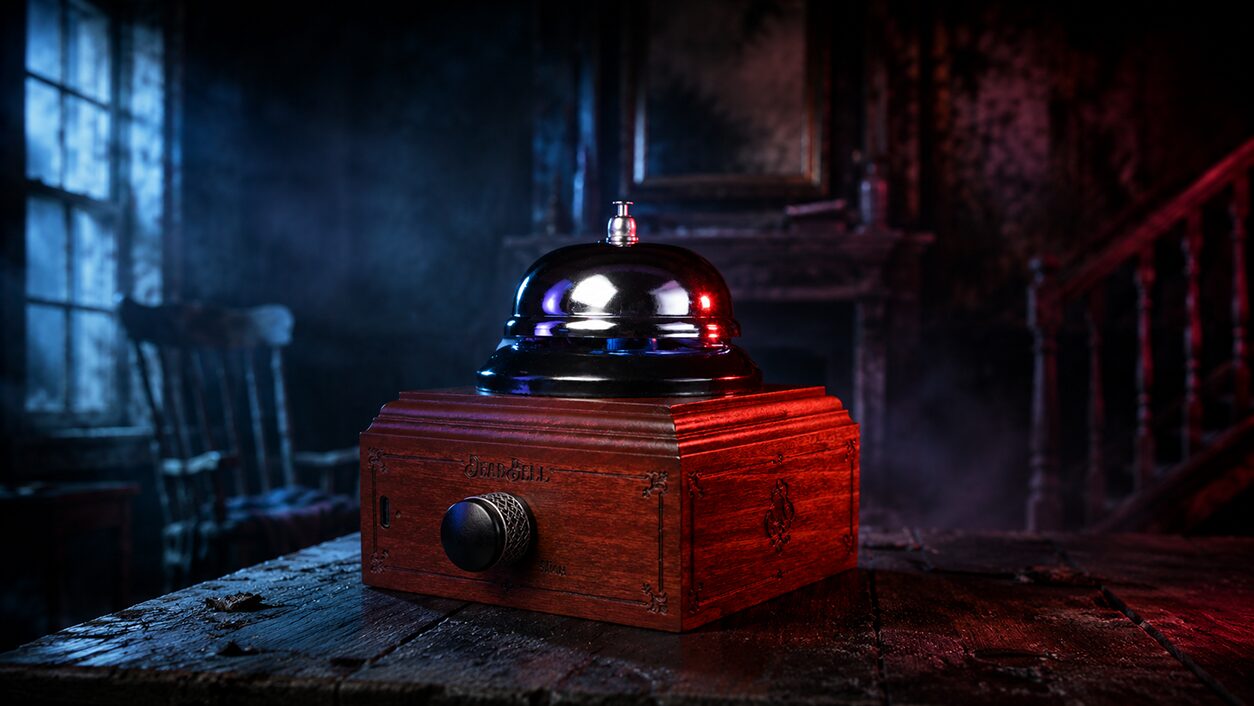
A Dead Bell is a vintage-style mechanical reception bell mounted on a hand-carved wooden base, with built-in electronics that allow it to ring in two distinct ways:
- By touch: like any normal reception bell, you can press the button on top and it rings via a traditional mechanical hammer.
- By environmental energy: an internal magnetometer detects fluctuations in natural magnetic fields. When those fluctuations cross a threshold, the bell’s mechanical hammer is triggered electronically, producing the exact same physical ring as a touch press.
The theory behind the device is that paranormal entities can either physically interact with the touch button or influence the magnetic environment enough to trigger the EMF sensor. Either interaction produces the same audible result: a single, clear mechanical bell chime. There’s no synthesized sound, no app, no screen. Just a real bell, ringing in a quiet room.
The Dead Bell is made by GhostStop, LLC, the paranormal gear manufacturer based in Lynchburg, Virginia. The current revision (released in 2024) uses a hand-crafted red mahogany wood base, carved in-house with GhostStop’s signature spooky filigree, made in the United States.
How a Dead Bell Works
The Dead Bell is structurally simple, which is part of its appeal. Three main components: the bell itself, the magnetometer, and the mechanical hammer assembly.
The Magnetometer
Inside the wooden base is a magnetometer that detects changes in the local magnetic field, measuring magnetic flux density up to ±160 mT. What makes this design notable: the sensor is specifically tuned for natural magnetic fields only, designed to filter out most man-made interference such as phones, two-way radios, and other common electronics that often trigger general-purpose EMF meters.
This matters for two reasons. First, it reduces false positives from common modern devices that investigators are usually carrying anyway. A standard EMF meter will go off near anyone’s pocket phone. The Dead Bell shouldn’t. Second, it means the device responds specifically to the kind of magnetic anomalies that paranormal investigators have long associated with reported activity, rather than to background electronics noise.
The Mechanical Hammer
When the magnetometer detects a magnetic spike that crosses the sensitivity threshold, an electronic signal triggers a traditional mechanical hammer assembly. The hammer strikes the inside of the brass bell, producing a clean, single chime. This is not a recorded sound or synthesized noise. It’s a real bell being struck by a real hammer.
This is what makes the Dead Bell distinct from a general-purpose EMF meter. Most EMF detectors signal their reading via LEDs, an audible electronic beep, or a digital display. The Dead Bell signals it via a physical, mechanical sound that’s identical to what would happen if someone walked up and pressed the button. The auditory experience is the same whether the trigger was a touch or an EMF spike.
The Sensitivity Control
A control knob on the front of the base allows the investigator to dial the sensitivity up or down to match the environment. In a quiet rural location, you can turn it up to catch even small fluctuations. In an environment with ambient EMF (older buildings with old wiring, locations near operational electronics, etc.) you turn it down so it only triggers on more significant spikes.
GhostStop’s own guidance is to start low, adjust upward until you reach a point where the device is generally quiet in the ambient environment, and then leave it. You can verify sensitivity quickly by moving a magnet near the base or moving the bell near a motor (a fan, for example) to test that the response is calibrated where you want it.
The Trigger Object Theory
The Dead Bell isn’t just an EMF detector with a clever output mechanism. It’s deliberately designed to fit a specific paranormal investigation methodology: the use of trigger objects.
The trigger object theory holds that paranormal entities are more likely to interact with locations or environments that contain familiar or meaningful objects from their earthly past. A doll for a child spirit. A piece of jewelry for someone who wore it in life. A tool from a particular trade for the worker who used it. The thinking is that these objects either retain a connection to the entity, or simply make the environment recognizable enough to invite interaction.
A reception bell is one of the most strongly recognizable objects of the 19th and early 20th centuries. Hotels, banks, post offices, train stations, doctor’s offices, mercantile counters: all of them had a bell on the front desk. Anyone who lived in that era would recognize one immediately. For paranormal entities associated with old buildings, old hotels, or old businesses, the Dead Bell functions doubly: as a trigger object that invites recognition, and as a tool whose primary function (ringing to summon someone) is precisely the kind of interaction an entity might be inclined to attempt.
That’s the framing that distinguishes the Dead Bell from other EMF-based investigation tools. It’s not just measuring; it’s inviting.
Why the Vintage Aesthetic Matters
It would be easy to dismiss the hand-carved wooden base and brass reception bell as cosmetic. They’re not. The aesthetic is functional in the context of paranormal investigation.
Three reasons:
- Recognition by entities: per the trigger object theory above, an object that looks like what it would have looked like in the period the location was active increases the probability of interaction.
- Atmosphere for the investigator: investigation methodology depends in part on staying calm, attentive, and patient. A piece of equipment that feels like a real object rather than a plastic gadget supports the kind of focus serious investigation requires.
- Documentation: footage of a Dead Bell ringing on its own is visually more compelling than footage of an EMF meter beeping. For investigators who publish their work (TV, YouTube, blogs like this one), the device produces evidence that translates well to video.
The new 2024 design uses hand-carved red mahogany wood, with each base individually crafted in GhostStop’s Lynchburg facility. The result is that no two Dead Bells are exactly identical. Wood grain, carving, finish all have subtle variations. GhostStop’s framing of this: “Each base carries its own quirks and personality, making your Dead Bell one-of-a-kind. No two are exactly the same, much like the spirits you seek.”
Technical Specifications
For investigators evaluating the Dead Bell against other equipment or considering portability for travel kits, the vitals:
- Size (2024 model): 4.25″ w x 4.25″ d x 4.5″ h
- Size (original model): 3.5″ w x 4.5″ d x 3.5″ h (smaller, found in earlier production)
- Enclosure: hand-carved red mahogany wood, individually crafted
- Sensor: built-in magnetometer for natural magnetic fields, ±160 mT flux density range
- Sensor filtering: tuned to natural magnetic only, fortified against most man-made interference (phones, walkies, etc.)
- Bell trigger: real traditional mechanical hammer
- Trigger types: touch button (top), EMF spike (automatic)
- Sensitivity: adjustable via front-mounted control knob
- Power: rechargeable internal battery via USB-C cable
- Battery life: ~7 hours under normal use; ~4 hours if triggering constantly
- Charging time: ~1 hour for a full charge
- Charging LED: red while charging, blue when full
- Optional add-on: USB battery pack for unlimited mobile use while charging
- Made in: United States (Lynchburg, Virginia)
Dead Bell vs Other EMF Devices
The Dead Bell is one of several EMF-based investigation devices on the market. Worth comparing it briefly to the most common alternatives so you understand where it fits.
Dead Bell vs Standard EMF Meter
A standard EMF meter (like the K-II or a Mel Meter) measures electromagnetic field intensity and displays it on LEDs or a digital readout. It’s a measurement tool. The Dead Bell measures essentially the same kind of phenomenon, but signals the reading via a mechanical bell ring rather than via lights or numbers.
The trade-off: an EMF meter gives you precise readings; the Dead Bell gives you a binary trigger event (rang or didn’t ring). Different use cases. Most investigators use an EMF meter for baseline mapping and a Dead Bell as a trigger object during specific interaction sessions.
Dead Bell vs Rem Pod
A Rem Pod creates an electromagnetic field around itself and detects when anything disturbs that field. When triggered, it sounds an electronic tone and lights up.
The Dead Bell is passive (it detects existing field changes) rather than active (it doesn’t generate its own field for entities to disturb). Some investigators find passive detection more credible because there’s no artificially created field that might be confounding the readings. Other investigators prefer the Rem Pod’s active approach. Both are common.
Dead Bell vs Cat Balls / Other Trigger Objects
“Cat balls” (small balls that light up when touched) are popular trigger objects, especially in cases involving child spirits or pets. The Dead Bell occupies a similar role but is designed for adult-era recognition (hotels, businesses, older buildings) rather than children’s environments. Most working paranormal investigators carry several trigger objects in their kit to match the suspected period and demographic of any given location.
A Skeptic’s Take
We try to be honest about what any paranormal device can and can’t prove. The Dead Bell is no exception.
Legitimate skeptical critiques:
- The Dead Bell is still an EMF detector. Most things that trigger an EMF detector are mundane: wiring, appliances, fluorescent lights, your own moving body. The magnetometer-only design filters out some interference, but not all.
- Vibration can trigger it. A heavy footstep nearby, a slamming door, a passing truck outside: any of these can cause enough physical or magnetic disturbance to trigger the bell.
- The dramatic output amplifies confirmation bias. A standard EMF meter shows a small LED flicker; a Dead Bell rings a literal bell in a quiet room. The emotional impact of the audible bell makes it easier to attach meaning to any given ring.
- Yes/No frameworks are imprecise. The common methodology of “ring once for yes, twice for no” depends on the assumption that an entity understands the convention, can produce two rings in coordinated sequence, and is being truthful. None of those are verifiable independent of the framework itself.
- No controlled studies. There are no peer-reviewed studies we’re aware of demonstrating that the Dead Bell’s outputs correlate with paranormal phenomena under controlled conditions.
The case for the Dead Bell:
- On-topic responsiveness: investigators consistently report bell responses that align with specific questions, particularly in yes/no frameworks. We’ve seen this pattern enough across enough investigation teams to take it seriously.
- Filtered sensor design: the natural-magnetic-only filtering is a meaningful design improvement over general EMF meters. It reduces false positives from common modern sources.
- Physical evidence: a real bell ringing is more documentable than an LED flicker. Video footage of a Dead Bell ringing without anyone near it is the kind of evidence that other investigators can review and critique.
- Independent investigator track record: GhostStop publishes 55+ verified reviews from working paranormal investigation teams, with consistent patterns of perceived efficacy across decades of combined field use.
Our honest read: the Dead Bell is one of the more interesting devices in modern paranormal investigation, both because of its design philosophy and because of the binary, documentable nature of its output. It’s not proof of anything on its own. But used in combination with other gear (a video camera running on it at all times, an EMF meter for baseline mapping, audio recording for EVPs), it produces the kind of converging evidence that makes patterns visible across a session.
How to Use a Dead Bell Well
If you do invest in a Dead Bell, getting useful results out of it requires more discipline than just turning it on and listening for chimes. Best practices we’d recommend:
- Start sensitivity low and dial up. Per GhostStop’s own guidance, turn the knob to the lowest setting first, then increase until the device is generally quiet in the ambient environment. Going the other direction (starting high) gets you false positives from normal background noise.
- Map the environment before the session. Walk through the room with an EMF meter or just your hand near the bell, noting any sources of magnetic disturbance: outlets, light switches, ceiling fans, AC units, old appliances. Knowing where the noise is helps you interpret the rings.
- Document with video. The Dead Bell’s value as evidence depends on video documentation. Set up a camera with a clear view of the bell, running for the entire session. A bell that rings on its own in front of a running camera is independently verifiable; a bell that rings with no recording is just an investigator’s word.
- Use a clear interaction framework. The standard approach: “Ring the bell once for yes, twice for no.” Establish this explicitly before asking questions. Repeat the framework periodically during long sessions.
- Ask one question at a time and pause. Speak the question out loud, then wait for response. Don’t stack multiple questions. The Dead Bell at its most credible is when a specific ring follows immediately after a specific question.
- Note the time and content of every ring. Keep a written log: time, question asked, response, anything else happening in the room. Patterns only emerge across the full record.
- Place it strategically and don’t move it during the session. Movement causes magnetic disturbance and can trigger false rings. Set it on a flat, stable surface and leave it there.
- Use period-appropriate environments. The Dead Bell’s design leans into early-1900s aesthetics. It’s likely to perform best in historic buildings (hotels, old businesses, period properties) than in modern homes where its presence is more aesthetically out of place.
- Combine with other tools. A spirit box, an EVP recorder, and an EMF meter running alongside the Dead Bell provide multiple data streams. Convergence across multiple devices is the strongest paranormal signal.
The investigators who get the most out of a Dead Bell treat it like a scientific instrument with a paranormal hypothesis attached, not like a magic toy. Like all paranormal investigation gear, the quality of your conclusions tracks the quality of your methodology.
Famous Dead Bell Locations and Reviews
One advantage of the Dead Bell being relatively new on the market: GhostStop has accumulated several dozen detailed customer reviews from working paranormal investigation teams, with specific locations and experiences documented. Some of the locations where the Dead Bell has been used and reviewed publicly:
- Ohio State Reformatory in Mansfield, Ohio
- Indiana State Sanatorium
- Missouri State Penitentiary in Jefferson City
- The Monroe House
- Multiple haunted hotels across Pennsylvania, with one investigator reporting bell activity at all six properties they visited
- Various private residences with haunted dolls, where investigators have reported using the Dead Bell to communicate with attached entities
The pattern across these reviews is consistent: investigators report responsive bell rings during yes/no question sessions, multiple-ring sequences that appear coordinated, and stronger activity in environments with significant historical and emotional context. As with any paranormal evidence, none of this is conclusive in isolation. As a body of independent reports across many investigation teams, it’s at least noteworthy.
Is the Dead Bell Worth Buying?
The Dead Bell has an MSRP of $239.95 and is on sale at $199.19 at the time of this writing. That puts it in the mid-tier of paranormal investigation equipment, more expensive than a basic EMF meter but significantly less than an Ovilus or full SLS camera.
Whether it’s worth the price depends on what you’re trying to do.
A Dead Bell is worth it if:
- You already own the entry-level kit (EVP recorder, EMF meter, possibly a spirit box) and want a tool that does something different.
- You investigate primarily in historic buildings (hotels, old businesses, period properties) where its aesthetic and methodology fit.
- You publish or document your investigations, where the bell’s audible, physical output translates well to video.
- You value the trigger object methodology and want a flagship trigger object in your kit.
- You appreciate the craft of hand-built equipment and the aesthetic of vintage-style investigation gear.
A Dead Bell is not the priority if:
- You don’t yet have basic gear. Start with an EVP recorder, EMF meter, and spirit box first.
- You investigate primarily modern locations where the vintage aesthetic feels out of place.
- You prefer purely quantitative readings (specific EMF numbers, frequency spectrums) over binary trigger outputs.
Where to Buy the Dead Bell
The Dead Bell is made and sold directly by GhostStop. There is no alternative retailer, since it’s a GhostStop original product, hand-built in their Lynchburg, Virginia facility.
- GhostStop: Check current Dead Bell pricing on GhostStop. The current 2024 hand-crafted mahogany version is the latest revision. An optional USB battery pack add-on is available for extended mobile use.
Because each Dead Bell is hand-crafted, expect minor variations between units. Stock can occasionally be limited based on production capacity.
Note: The GhostStop link above is an affiliate link. If you buy through it, we may earn a small commission at no additional cost to you. For full details, see our Affiliate Disclosure.
Frequently Asked Questions
What is a Dead Bell?
A Dead Bell is a vintage-style mechanical reception bell mounted on a hand-carved wooden base, built with an internal magnetometer that can trigger the bell mechanically when it detects natural magnetic field fluctuations. It’s used in paranormal investigations as both an EMF detector and a trigger object.
How does a Dead Bell work?
The Dead Bell has two ways to ring. Pressing the button on top works like a normal reception bell. The built-in magnetometer also automatically triggers a mechanical hammer when it detects magnetic field changes that cross the sensitivity threshold. Either way, the same real brass bell rings.
Who makes the Dead Bell?
The Dead Bell is manufactured by GhostStop, LLC, a paranormal investigation gear company based in Lynchburg, Virginia. Each unit is hand-built in the United States with a hand-carved red mahogany wood base.
How much does a Dead Bell cost?
The Dead Bell has an MSRP of $239.95 and is currently on sale at $199.19 from GhostStop. An optional USB battery pack add-on is available separately. Pricing is subject to change, so check the current product page for the latest.
What kind of sensor does the Dead Bell use?
The Dead Bell uses a magnetometer specifically tuned for natural magnetic field detection, with a flux density range up to ±160 mT. The sensor is filtered against most man-made interference such as phones and two-way radios, reducing false positives from common modern electronics.
How is a Dead Bell different from a regular EMF meter?
A standard EMF meter shows readings via LEDs or a digital display. The Dead Bell signals readings via a real mechanical bell ring, identical to a touch press. The Dead Bell is also filtered for natural magnetic fields only, while general EMF meters detect a wider range of electromagnetic activity. The Dead Bell functions as both a detector and a trigger object; a standard EMF meter is purely a measurement tool.
How long does the Dead Bell battery last?
The Dead Bell’s internal rechargeable battery lasts approximately 7 hours under normal use, dropping to about 4 hours if the sensor is being triggered constantly. Charging takes about an hour via the included USB-C cable. The device can also be used continuously when plugged into a wall outlet or a USB battery pack.
Can a Dead Bell be used by beginners?
Yes, the Dead Bell is straightforward to use. Turn it on, adjust sensitivity with the knob, and place it on a flat surface. However, beginners are generally better served by building out the foundational kit (EVP recorder, EMF meter, spirit box) before adding mid-tier specialty gear like the Dead Bell.
Is the Dead Bell waterproof or weather-resistant?
No. The Dead Bell has a real wood enclosure with internal electronics and should be treated as an indoor device. Avoid moisture, weather exposure, and rough handling.
The Bottom Line
The Dead Bell is one of the more distinctive pieces of paranormal investigation equipment available right now. The combination of vintage aesthetic, filtered EMF detection, and mechanical bell output puts it in a category mostly by itself. It’s not the cheapest device in a paranormal kit, but it does something that few other devices do: it produces a clearly audible, physically documentable response to environmental changes, in a form that fits naturally into the trigger object methodology paranormal investigators have used for decades.
Like all paranormal investigation tools, it isn’t proof of anything on its own. The same magnetic fluctuations that ring the bell could come from completely mundane sources. The patterns of rings that align with questions could be coincidence amplified by confirmation bias. We try to stay honest about all of that.
But the device design is intentional and the sensor is purpose-built. The documentation of working investigation teams using it across many high-profile haunted locations is substantial. And the combination of trigger object theory with a real, mechanical bell ringing in a quiet historic room is something it’s worth experiencing firsthand to understand.
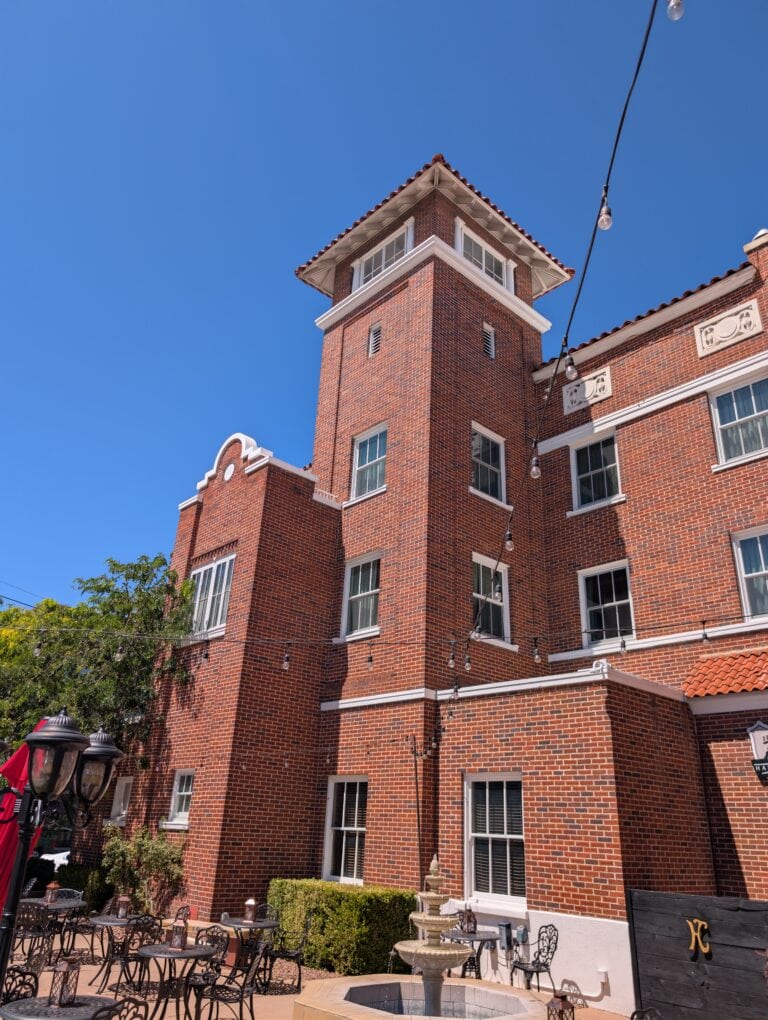
We’ve since taken our Dead Bell on its first real investigation, a night in Room 319 at the Hassayampa Inn in Prescott. We set the sensitivity about a third of the way up, and it rang during the same windows our Ovilus was producing its strongest output. We’re still dialing in the right sensitivity for hotel rooms. Read the full results in our Hassayampa Inn field report.
If you’ve used a Dead Bell on your own investigations, we’d love to hear what your experience has been. Send us your story through our contact page. Firsthand accounts go into our paranormal experiences archive.
For more honest guides to paranormal investigation equipment, see our Our Gear page or browse our Equipment Reviews archive. For new posts as they’re published, subscribe to the newsletter. No fluff. No dramatization. Just the gear, the methodology, and what actually works.