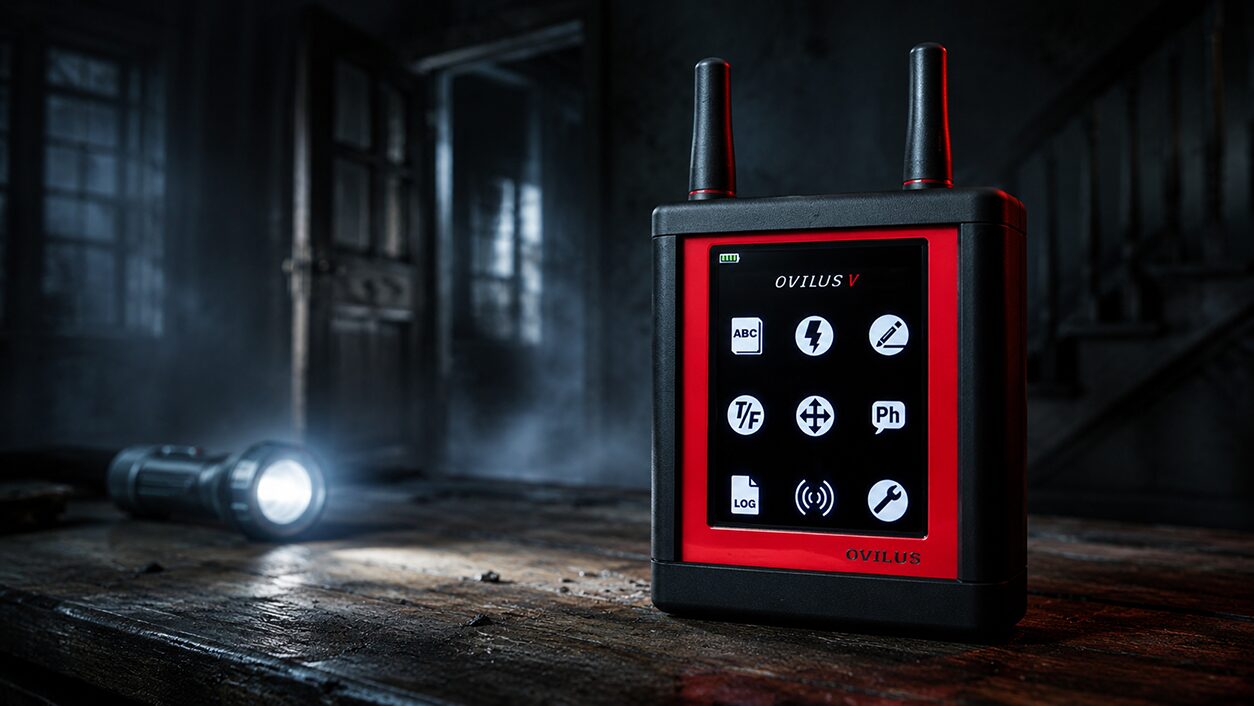
You’re standing in a dark hallway of a hotel that has been haunted for a hundred years. A small handheld device on the table in front of you flickers, beeps, and speaks a single word out loud in a synthesized voice: “Bailiff.” The hotel is directly across the street from a working courthouse.
That device is an Ovilus. And whether the word it just spoke means anything is the central question that paranormal investigators have been asking for almost twenty years.
The Ovilus is the most famous piece of paranormal investigation equipment ever made. It has appeared on essentially every major paranormal TV show, including Ghost Adventures, Ghost Hunters, and dozens of independent investigation channels. Its inventor has become a recurring figure in the paranormal world. The device has gone through five major revisions, generated countless viral “how did it know” moments online, and developed both passionate believers and equally passionate skeptics.
If you’re new to paranormal investigation gear, or thinking about buying your first serious device, the Ovilus is one of the most-asked-about pieces of equipment in the field. This guide covers everything we know about it: what it is, how it works, the five versions, what to make of it skeptically, how to use it well, and whether it’s worth the price.
What Is an Ovilus?
An Ovilus is a handheld electronic device designed to convert environmental sensor readings into spoken words from a built-in dictionary. The theory behind the device is that paranormal entities can influence environmental factors (electromagnetic fields, temperature, etc.) in subtle ways, and that those influences can be channeled through the device into intelligible speech.
In practical terms, you turn it on, place it in the space you’re investigating, and listen. The device monitors its sensors continuously. When sensor readings change in particular ways, the device selects a word from its dictionary and speaks it aloud through a built-in speaker. Some words match the moment in interesting ways. Most don’t. The pattern of which words show up, and when, is what investigators try to evaluate.
The Ovilus was created by Bill Chappell, founder of Digital Dowsing. As of 2023, Digital Dowsing has become part of GhostStop, LLC, and GhostStop now manufactures the Ovilus directly under Bill Chappell’s continuing direction. The current production model is the Ovilus 5b, the latest revision of the fifth-generation device.
How an Ovilus Works
The Ovilus is built around three core components: environmental sensors, a dictionary, and a translation system that maps the first to the second.
The Sensors
The Ovilus monitors environmental conditions in real time. Depending on the mode you’re using, those readings can include:
- Electromagnetic field (EMF) readings
- Temperature and energy changes in the immediate environment
- Motion and vibration via a built-in accelerometer
- Proximity sensing with a triggerable threshold
These are the same kinds of environmental factors that EMF meters and thermometers track separately. The Ovilus combines them into a single multi-sensor device with multiple modes for displaying or interpreting that data.
The Dictionary
Inside the device is a built-in dictionary of 2,048 predefined words. These include common nouns, verbs, adjectives, names, places, emotional terms, body-related words, and time-related words. The dictionary has remained largely consistent across versions of the Ovilus, which Digital Dowsing has described as part of the device’s identity. They refer to it as a kind of standardized language that entities have, in their words, “learned” to use across nearly two decades of investigation use.
The Translation (and Why It’s Not Random)
This is the technical part that gets debated most, and the part where Digital Dowsing has been the most emphatic over the years.
According to the manufacturer, the Ovilus does not use random word generation at any point. This is one of the most repeated claims on the official product page: “No random words were harmed (or even used) in the making of this device.” The readings-to-word system specifically chooses a word from the dictionary based on specific environmental readings, not from a randomizer.
The general framework: sensor readings are converted into numerical values. The magnitude of energy changes detected by the device is used to select one of the 2,048 dictionary words. The same input pattern produces the same word, every time. That makes the device deterministic at the sensor-to-word level. The variability is in the environment, not in the algorithm.
Whether the environmental inputs that cause those word selections are paranormal in origin is a separate question. We’ll come back to that in the skeptic’s section.
The 8 Modes of the Ovilus 5
The Ovilus 5 includes eight distinct modes, each presenting environmental data in a different way. Investigators tend to develop preferences for which modes produce the most meaningful results in different environments. A quick breakdown of all eight:
1. Dictionary Mode
The signature mode. The device selects from its 2,048-word dictionary based on environmental readings and speaks each word aloud while displaying it on the touch screen. The last three words spoken remain visible, with longer history available in Log Mode.
2. Phonetic Mode
Instead of pulling from the dictionary, Phonetic Mode generates phonemes, the building blocks of speech. This allows for words that aren’t in the dictionary to potentially form, including names, places, slang, and words from other languages. Useful when investigating locations where specific names or non-English communication might be expected.
3. Draw Mode
Instead of words, environmental changes are converted into colored pixels drawn across the screen. The theory is that visual patterns or images could potentially form through this mode, allowing entities to communicate visually rather than verbally. A different angle on ITC (instrumental transcommunication) experimentation.
4. Energy Mode
Displays a real-time sine wave graph of electromagnetic field readings, similar to an oscilloscope. Unlike a standard EMF meter (which typically shows an averaged number), Energy Mode shows the dynamic shape of the field over time. Useful for visualizing how active and changing the EMF environment actually is.
5. True/False Mode
Provides a simple bi-polar response. The screen shows a green light when energy readings increase and a red light when they decrease. Useful for asking direct yes/no questions, true/false questions, or other binary queries during an investigation.
6. Motion Mode
Uses the device’s built-in accelerometer to detect motion and vibration. Designed to pick up small movements that might indicate footsteps, objects shifting, or physical disturbances in the environment.
7. Proximity Mode
Shows energy levels in a radial graph with a proximity trigger. Similar to Energy Mode in the data it processes, but with a different visualization and a built-in alert when readings cross a threshold. Useful for stationary placement in a room to detect when something approaches.
8. Log Mode
Displays the full log of words spoken during the current Dictionary Mode session. Critical for documenting an investigation rather than relying on memory. Patterns only become visible across the full word list.
The Ovilus 5 also includes a Settings screen for adjusting volume, voice (male or female, English or Spanish), and other operational preferences.
A Brief History: Bill Chappell and Digital Dowsing
The Ovilus exists because of one person: Bill Chappell, the founder of Digital Dowsing.
Chappell started his career as a software engineer, with experience in coding, electronics, and embedded systems. In the mid-2000s, he became interested in paranormal investigation and started experimenting with ways to combine consumer electronics with paranormal research methodology. He has described himself in interviews as a “techgnostic,” someone who believes that the unexplained can be approached through technology rather than purely through traditional spiritual practices.
His early devices were experimental prototypes, often hand-built and tested at known haunted locations. The first commercial Ovilus appeared around 2008, and the device became immediately popular in the paranormal investigation community. Within a few years, Digital Dowsing had become one of the most recognizable brands in the field, and Chappell himself had become a recurring presence on paranormal television.
In addition to the Ovilus, Digital Dowsing has produced a long list of other paranormal devices over the years:
- The Mel Meter, a popular EMF + temperature meter
- The Geoport, a real-time word translation device
- The Polterpod, a multi-function paranormal communication device
- The Dead Bell, a sensor-triggered bell that signals environmental changes
The Ovilus, though, has always been the flagship. It is the device most associated with Chappell, and the one that most paranormal investigators encounter first.
The GhostStop Partnership
As of 2023, the production of the Ovilus has formally transitioned. Digital Dowsing has become part of GhostStop, LLC, the major paranormal gear retailer based in Lynchburg, Virginia. GhostStop now manufactures the Ovilus directly, under Bill Chappell’s continuing direction.
Chappell’s own framing of the transition: “For me, this passing of the torch is a chance to entrust the next generation with the technology and passion that I’ve been developing for so many years.”
What this means practically: the Ovilus brand and design continue under the same inventor’s vision, but with new manufacturing infrastructure behind it. The Ovilus 5b (the current revision) reflects this new production capability, with a molded rugged enclosure replacing the 3D-printed shells of earlier 5-series units.
The Five Versions: A Quick Timeline
Each version of the Ovilus has expanded sensors, dictionary, and modes. A quick history of where the device has been:
- Ovilus I (late 2000s): the original. Single-mode dictionary device based on EMF readings. Established the core concept.
- Ovilus II: refined sensors and dictionary. Added phonetic mode.
- Ovilus III: added a color screen, more modes, and a larger dictionary. Considered by many investigators to be the breakthrough version.
- Ovilus IV: continued refinements, additional features, improved hardware.
- Ovilus 5 (and its current revision, the Ovilus 5b): the latest version. Multiple sensors, the 8 modes detailed above, full color touch screen, multiple voice options, and the most refined version of the device to date.
Older Ovilus devices show up in the used market occasionally. If you’re considering one of those, be aware that batteries, sensors, and supported features vary significantly across versions. The Ovilus 5b is what’s currently produced and supported.
What’s New in the Ovilus 5b
The Ovilus 5b is the latest revision of the fifth-generation device. Specific improvements over earlier 5-series units include:
- Molded rugged enclosure: replaces the 3D-printed shells of earlier Ovilus 5 units. Cleaner build, more durable, more consistent unit-to-unit quality.
- New red faceplate: distinctive visual signature for the 5b revision.
- Free protective case included with purchase (limited-time promo as of this writing).
- Full 8-mode operation: Dictionary, Phonetic, Draw, Energy, True/False, Motion, Proximity, and Log modes, all accessible from a touchscreen home menu.
- Multiple voice options: Male English, Female English, Male Spanish, Female Spanish.
- Long-life rechargeable internal battery with on-screen battery indicator.
Technical Specifications
For investigators who want to compare specs against other gear or evaluate portability for travel kits, the Ovilus 5b’s vitals:
- Size: 4.25″ h x 3.15″ w x 1.25″ d
- Weight: 0.4 lbs
- Display: Full color touch screen
- Battery life: 12 to 20 hours of run time depending on mode, settings, and detection rate
- Charging: USB-Mini to USB cable, with rechargeable internal battery
- Voice options: Male English, Female English, Male Spanish, Female Spanish
- Headphone port: Standard 3.5mm audio jack
- Dictionary: 2,048 predefined words (Dictionary Mode)
The full official word list is available via Digital Dowsing’s published reference at digitaldowsing.com, though investigators familiar with the device know that knowing the full dictionary doesn’t predict which words come through in a given session.
Ovilus vs Spirit Box vs Phone Apps
One of the most-asked questions in paranormal gear discussions: how does an Ovilus compare to the other word-generating devices on the market? Three categories are worth distinguishing.
Ovilus vs Spirit Box
A spirit box (the P-SB7T being the most common model) sweeps through AM and FM radio frequencies rapidly, generating a continuous wash of audio fragments from broadcast signals. The theory is that paranormal entities can manipulate the audio to form intelligible words or phrases.
An Ovilus, by contrast, doesn’t use radio at all. It generates words from its built-in dictionary based on environmental sensor readings. There is no broadcast signal involved.
Functional differences:
- Audio quality: Spirit box output is degraded radio noise. Ovilus output is clean synthesized speech.
- Vocabulary: Spirit box can produce any word in any radio broadcast. Ovilus pulls from a defined 2,048-word dictionary.
- Skeptic critiques: Spirit box is susceptible to apophenia (hearing patterns in noise). Ovilus has its own set of critiques (which we’ll cover) but, per the manufacturer, doesn’t include random word generation.
- Sound: Spirit box is loud and continuous. Ovilus is intermittent and quieter.
Many investigators use both. They complement each other well. A spirit box session and an Ovilus session in the same location often produce different types of results.
Ovilus vs Phone Apps
Numerous phone apps claim to perform similar functions to an Ovilus. They’re typically much cheaper (often free) and use the phone’s sensors plus a built-in word list.
The honest read on phone-based “Ovilus apps”: most of them are not credible. Phone sensors are designed for completely different purposes than paranormal investigation. They produce noisy data that gets interpreted through whatever the app developer decided. Many apps appear to generate words from a random number generator with minimal actual sensor input, which is precisely what the real Ovilus emphasizes it does not do.
The real Ovilus uses purpose-built sensors integrated into a device specifically calibrated for the task. That’s why it costs significantly more than a free app and why investigators serious about word-generation devices tend to invest in a real Ovilus rather than relying on the apps.
That said, we’ve used phone apps in field tests and gotten interesting results from them. They aren’t worthless. But the reasonable skeptical baseline is much higher for any phone app than for a real Ovilus.
A Skeptic’s Take
The Ovilus is one of the most-debated devices in paranormal investigation. There are honest skeptical objections worth taking seriously, and there are honest reasons to find the device compelling. We try to be transparent about both.
What’s NOT a valid skeptical critique: claiming the Ovilus randomly generates words. The manufacturer is explicit and consistent on this point: the device uses a deterministic mapping from environmental readings to dictionary words. The same input produces the same output. That isn’t randomness.
What ARE legitimate skeptical critiques:
- Apophenia: the human tendency to find meaningful patterns in data, including patterns that aren’t really there. Even with a deterministic word-selection process, the matching of any particular word to a particular moment can feel meaningful when it’s actually coincidence.
- Curated dictionary: 2,048 words is large enough that, across a session, emotionally resonant words will appear. The dictionary is curated to include terms that resonate in paranormal contexts. That alone increases the probability of feeling-meaningful matches.
- Environmental triggers are mostly mundane: EMF and temperature changes happen constantly in indoor environments. Wiring, appliances, foot traffic, weather, building HVAC, your own body. The device responds to all of those whether anything paranormal is present or not.
- No controlled studies: we don’t know of any peer-reviewed scientific study that has tested whether Ovilus outputs correlate with paranormal phenomena under controlled conditions.
- Confirmation bias: investigators using an Ovilus are typically already expecting some kind of paranormal communication. That expectation shapes interpretation.
The case for the Ovilus:
- On-topic responsiveness: investigators report that the words coming through often respond to specific questions, in moments where coincidence alone would be statistically unlikely. We’ve experienced this ourselves with similar devices.
- Deterministic, not random: the device is explicitly designed not to randomize its outputs. If the same environmental pattern reliably produces the same word, then the question shifts from “is the word random?” to “what’s causing the specific environmental patterns the device is reading?”
- Investigator track record: serious paranormal investigators with years of field experience continue to use the device. That’s not proof, but it’s not nothing either.
- Bill Chappell’s credibility: he is a software engineer with technical background, not a mystic. His public explanations of how the device works have been transparent and consistent across nearly two decades of public visibility.
Our honest read: an Ovilus on its own is not proof of paranormal activity, but it is a useful data input alongside other evidence. The most credible use is in combination with other gear (spirit box, EMF meter, SLS camera, audio recording for EVPs) where multiple devices producing converging signals make a stronger pattern than any single device could on its own.
How to Use an Ovilus Well
If you do invest in an Ovilus, getting useful results out of it requires more discipline than just turning it on and listening. Best practices we’d recommend:
- Let the device settle. Per the manufacturer’s own guidance, the Ovilus will voice many words during normal operation as natural environmental changes trigger the sensors. Give it time to stabilize, and if it’s voicing constantly, try moving it to a different area to settle it down before treating outputs as meaningful.
- Establish a baseline. Run the Ovilus in a known non-active environment (your home, a quiet outdoor space) for ten or fifteen minutes. Note the rate and types of words it produces with no paranormal context. This gives you a comparison point.
- Identify nearby EMF sources. The Ovilus reacts to electromagnetic fields. Phones, routers, fuse boxes, fluorescent lights, and old wiring can all influence its output. Map the EMF environment before you draw conclusions about what the device is responding to.
- Place it stationary rather than carrying it. Multiple investigator reviews emphasize that the device produces more meaningful results when stationary. Carrying it around generates motion noise that the sensors interpret as activity. Set it on a flat surface and let it work.
- Ask specific questions out loud. Don’t just turn it on and listen. Address whoever might be present, pause, and listen for response. The Ovilus is at its most credible when words appear immediately after a specific question.
- Document every word and the time it appears. Don’t rely on memory. Log Mode helps, but supplement with your own notes including what you’d just asked and what was happening when each word came through.
- Record audio in parallel. Run an EVP recorder while the Ovilus is going. If something is happening, you want multiple captures of it.
- Set a high bar for what counts as a response. The word needs to be on-topic, fast, and clearly intelligible. A word that arrives ten minutes after a question, or that’s only loosely related to what you asked, is harder to attribute to the question.
- Compare across multiple sessions. One session at one location is interesting. Patterns across multiple sessions at the same location, or the same word repeating across different sessions, is much more compelling.
The investigators who get the most out of an Ovilus treat it like a scientific instrument with a paranormal hypothesis attached, not like a magic 8-ball. The difference shows up in the quality of the conclusions.
Famous Ovilus Moments in Paranormal TV
Part of the Ovilus’s cultural footprint is the number of “viral” moments it has produced on paranormal television and YouTube. A few that have become well known in the community:
- Ghost Adventures has used Ovilus devices on numerous investigations, including high-profile locations like the Stanley Hotel, Bobby Mackey’s Music World, and various American prisons and asylums.
- Ghost Hunters investigators have used and discussed the device in multiple episodes, often with mixed reactions about what its outputs mean.
- Bill Chappell himself has appeared on multiple paranormal shows to demonstrate the device, explain how it works, and respond to investigators’ questions.
- YouTube investigators have generated countless videos featuring “how did it know” Ovilus moments. The credibility of these varies significantly by channel and methodology.
The pattern across all of these moments is the same: a specific word arrives at a specific time that matches the context too well to be easily explained as coincidence. Whether that’s evidence of paranormal communication or evidence that the human brain is excellent at noticing meaningful matches is the central question.
Is the Ovilus 5b Worth Buying?
The Ovilus 5b is not cheap. At an MSRP of $599.95 (currently on sale at $579.19), it sits in the premium tier of paranormal investigation equipment, well above entry-level gear like a basic EMF meter or audio recorder.
Whether it’s worth the price depends on how serious you are about paranormal investigation. Our honest assessment:
An Ovilus 5b is worth it if:
- You already own the entry-level gear (EVP recorder, EMF meter, spirit box) and want to expand
- You investigate consistently and want a tool you’ll get repeated use out of
- You’re frustrated with phone-app word generators and want the real thing
- You’re documenting investigations publicly (a blog, YouTube channel, podcast) and want devices with established credibility
An Ovilus 5b is not worth it (yet) if:
- You haven’t done many investigations and don’t yet know whether you’ll stick with the hobby
- You don’t yet own basic gear
- Budget is tight and the device would crowd out other tools you’d use more
For anyone in the second category, we’d recommend building out the basic kit first (audio recorder, EMF meter, possibly spirit box) before investing in an Ovilus. The Ovilus is a great tool, but it works best as a complement to the basics, not as a starting point.
Where to Buy the Ovilus 5b
Since GhostStop is now both the manufacturer and the primary retailer for the Ovilus, the answer is simpler than it used to be. The Ovilus 5b is available at:
- GhostStop: the manufacturer and primary retailer. Current pricing, current model, current promo (free protective case as of this writing). Check current Ovilus 5b pricing on GhostStop.
We don’t recommend buying used Ovilus devices from third-party sites unless you know what version you’re getting and the seller is verifiable. Older versions can be tempting because of lower prices, but feature parity with the current Ovilus 5b is significant. The 5b also has the upgraded molded enclosure and current production support, which earlier units lack.
Note: The GhostStop link above is an affiliate link. If you buy through it, we may earn a small commission at no additional cost to you. For full details, see our Affiliate Disclosure.
Frequently Asked Questions
What is an Ovilus used for?
An Ovilus is used in paranormal investigations to attempt communication with whatever paranormal entities might be present in a location. The device converts environmental sensor readings into spoken words from a built-in dictionary. Investigators ask questions out loud and listen for words that match or respond to those questions.
How does the Ovilus work?
The Ovilus monitors environmental factors like electromagnetic fields, temperature, motion, and proximity in real time. When sensor readings change in specific ways, the device selects one of 2,048 predefined dictionary words and speaks it aloud through a built-in speaker. The manufacturer is explicit that no random word generation is used; the same environmental input pattern produces the same word output.
Who invented the Ovilus?
The Ovilus was invented by Bill Chappell, founder of Digital Dowsing. Chappell is a software engineer who has been making paranormal investigation devices since the mid-2000s. As of 2023, Digital Dowsing has become part of GhostStop, LLC, which now manufactures the Ovilus directly under Bill Chappell’s continuing direction.
How much does an Ovilus 5b cost?
The Ovilus 5b currently has an MSRP of $599.95 and is on sale at $579.19 from GhostStop, the manufacturer. A free protective case is included with purchase for a limited time. Pricing may change, so check the current product page for the latest.
Does the Ovilus use random word generation?
No. The manufacturer is explicit and consistent on this point. The Ovilus uses a deterministic mapping from environmental sensor readings to dictionary words. The same input produces the same output, every time. The variability in word selection comes from the changing environment, not from a randomizer inside the device.
How many modes does the Ovilus 5 have?
Eight modes: Dictionary, Phonetic, Draw, Energy, True/False, Motion, Proximity, and Log. Each mode interprets environmental data differently, giving investigators multiple ways to engage with a location. A Settings screen also allows adjustments to voice, language, and volume.
Is the Ovilus app the same as the real Ovilus?
No. The official Ovilus is a standalone hardware device with purpose-built sensors. Various phone apps claim similar functionality, but most rely on phone sensors not designed for paranormal investigation, and many do appear to use simple random word generation, which the real Ovilus emphatically does not.
Has the Ovilus been used on TV?
Yes. The Ovilus has appeared on Ghost Adventures, Ghost Hunters, and many other paranormal investigation TV shows. Bill Chappell, the device’s inventor, has personally appeared on multiple shows to demonstrate the device.
Should beginners buy an Ovilus?
The Ovilus 5b is a premium device at nearly $600. Beginners are typically better served by starting with cheaper foundational gear like an EVP recorder, EMF meter, and spirit box. Once you have experience with the basics and know you want to invest further, the Ovilus 5b becomes a meaningful upgrade.
The Bottom Line
The Ovilus is one of the most distinctive pieces of paranormal investigation equipment ever built. It has shaped how a generation of investigators think about communicating with the unexplained, and it has earned its place on shelves and in investigation kits around the world.
Like any paranormal tool, it isn’t proof of anything on its own. The matches between words and moments could be confirmation bias. The environmental readings the device translates could be entirely mundane in origin. We try to stay honest about that.
But over the course of years of investigations, with multiple devices running and careful documentation, patterns sometimes emerge that are hard to dismiss. The Ovilus is one of the devices most likely to be in the middle of those patterns. That’s why it has the reputation it has.
We’ve since added an Ovilus 5b to our own kit and taken it on its first real investigation, a night in Room 319 at the Hassayampa Inn in Prescott. It needed time to acclimate to the room before its output was usable, and then it produced some of the most on-topic words we’ve ever recorded, including Palace one block from the Palace Saloon. Read the full results in our Hassayampa Inn field report. We’ll keep adding findings as we use it at more locations.
If you’ve used an Ovilus on your own investigations, we’d love to hear what your experience has been. Send us your story through our contact page. Firsthand accounts go into our paranormal experiences archive.
For more honest guides to paranormal investigation equipment, see our Our Gear page or browse our Equipment Reviews archive. For new posts as they’re published, subscribe to the newsletter. No fluff. No dramatization. Just the gear, the methodology, and what actually works.